
Yes, the scroll bar is very small…but i’ve stuffed a lot of the content of this essay that isn’t that important in the appendix. The actual meat of it is smaller than the scrollbar makes it seem.
1: Mysterious Cosmic Fortune
There are a lot of very mysterious and unexpected things about physical reality, the strangeness of which is easy to overlook because of their foundationality to our lived experience; they don’t “stick” out to be noticed, much less be labeled as such. Say, the mere fact that it’s comprehensible. No less than Einstein thought: “The eternal mystery of the world is its comprehensibility…The fact that it is comprehensible is a miracle”. One could say much the same thing about its order and regularity, which, after all, is part of what enables it to be comprehensible. But shouldn’t chaos and disorder be the expectation? There seem to be significantly more ways for a system to be disordered than ordered. Or take the nature of its mathematical laws, the simplicity of which helps us cognize the universe to a stunning degree. Or the precise values of its initial conditions and constants, inhabiting a tiny, seemingly improbable, and life-permitting range amongst a vast sea of inhospitable possibilities. The list can go on; there are many examples of fundamental features of physical reality that not only enable our existence, but moreover, allow for the possibility of leading meaningful, significant, and prosperous lives. Physical reality seems like it could’ve been a different way, or, stranger yet, we should even, in certain cases, expect it to be a different way! In such cases, that it is the specific way it is, is not only unexpected, but also fortunate.
2: More Unexpected Things, Explanations, and the Structure of this Essay
In this essay, I want to explore yet another unexpected, but quite fortunate, feature of reality: the applicability of math. More specifically, that math can be so effective in furthering our understanding of the physical world, despite its developmental methodology. Why are mathematical concepts that are developed without a care for physical application, and guided not by empirical adequacy but instead by our parochial, biologically endowed notions of what is beautiful, convenient, simple, and entertaining, nonetheless able to describe the most fundamental, remote, and experientially disconnected behaviors of the physical universe? As Albert Einstein wondered: “How is it possible that mathematics, a product of human thought that is independent of experience, fits so excellently the objects of physical reality?“. Another renowned physicist, Paul Dirac, echoed a similar sentiment: “The mathematician plays a game in which he himself invents the rules while the physicist plays a game in which the rules are provided by Nature, but as time goes on it becomes increasingly evident that the rules which the mathematician finds interesting are the same as those which Nature has chosen”.
Einstein and Dirac weren’t peculiar in this line of questioning, many other physicists, mathematicians, and philosophers have voiced much the same sentiment. Eugene Wigner is another such example, and this essay, along with the broader philosophical literature on this topic, owes much to Wigner’s discussion of the problem in his seminal paper “The Unreasonable Effectiveness of Mathematics In the Natural Sciences”. Like Einstein and Dirac, Wigner was also a decorated physicist (winning the Physics Nobel prize in 1963). Yet, despite his obvious and intimate familiarity with both math and physics, the relationship between them still struck him as “unreasonable” and “miraculous”.
Now, before we move on, it’s worth considering the emphasis i’m placing on things like “strangeness”, and “unexpectedness”. It’s because what we perceive as unexpected (or improbable/strange/surprising/unlikely/mysterious/pick your synonym!) strongly surfaces a fundamental aspect of the human experience: the search for explanations. To be clear, explanations are sought after for various reasons, even for entirely expected things as well. But things that are unexpected, in a sense, cry out more for explanation. Thus, the unexpectedness of a phenomenon is one dimension, amongst others, that is relevant to its explanatory “need”, or more simply, our desire to explain it. After all, if you were to see a morbidly obese seal in the middle of a city street, that would warrant more explanation, and seem more worthy of seeking out an explanation for, than seeing a dog in said street.
I’m trying to say that, upon investigation, the effectiveness of math is like the morbidly obese seal: rotund, cute, and unexpected. So, the two objectives of this essay will be, first, to establish that the effectiveness of math is indeed unexpected, strange, and so on, which marks it as prima facie something worth seeking an explanation for, and, second, to assess various explanations of said unexpectedness. To that we now turn.

Alright, to that we now turn (actually).
3: A Little Setup
 In the introduction, I mentioned that math being “effective in enabling and furthering our understanding of the world” was strange. Before we get into why it’s strange, some elaborations are due. First of all, what do I mean by “understanding of the world” and how does math help us do that? What I mean specifically is that math can so accurately describe, and sometimes even contribute to the discovery of, the fundamental behavior of the physical world, which is expressed through the laws of physics, all of which are formulated mathematically. I’m using “laws of physics” pretty expansively. Newton’s law of universal gravitation has “law” in its name, but Einstein’s field equations in the theory of General Relativity don’t. Yet, both of these are what I would consider “laws of physics”, to co-opt popular terminology. What unites them is that they are mathematical descriptions (equations are descriptions) that are accepted as profitable descriptions of some fundamental feature/behavior of the universe, within their domain of applicability. Even something more specific, like the Navier–Stokes equations, used to describe the motion of fluids, would fit the bill. All such mathematical descriptions, what I refer to as the “laws” of physics, contain, within their statement, mathematical concepts. So, fully specified, the usage of math we are concerned with is that of the mathematical concepts that are used in the mathematical formulations of the laws of physics, thereby enabling us to describe the fundamental behavior of the world. It is such a usage that I claimed was strange and will try to explain throughout this essay.
Now, there are of course myriad other usages of math that I suppose one could also say help us “understand the world” beyond those relevant to the laws of physics, such as those in fields/endeavors besides physics (e.g., modeling population growth in ecology, assessing risk when trading financial assets - the examples are endless). Even within physics there are various usages of math. For example, once the laws of physics are formulated mathematically, one can calculate/solve them for given values. But this role of calculation seems a rather banal one: Wigner rightfully comments, “the role of evaluating the consequences of already established theories is not the most important role of mathematics in physics. Mathematics, or, rather, applied mathematics, is not so much the master of the situation in this function: it is merely serving as a tool.” Physics concerns itself with understanding the behavior of the physical world in terms of its fundamental constituents (energy, matter, force, etc) and their relationships. A large part of this understanding is expressed through mathematical descriptions of physical phenomena (i.e., the aforementioned “laws” of physics). Thus, the usage of math we are concerned with is at the very core of physics and is indispensable to our understanding of the universe. While the success of some of the other usages of math may also be unexpected, I’m narrowing the usage of math that concerns us to be something that is most obviously significant, even if there may be other cases that are likewise unexpected.
4: Is Math Actually Effective in that Role?
Before discussing why Math aforementioned role is supposedly strange and unexpected, it’s worth considering whether math is even effective in that role in the first place. After all, if we can only mathematically describe a few fundamental behaviors of the world and those descriptions are horrible approximations, there wouldn’t be much to discuss!
Since I’m writing this, you can probably surmise math is indeed effective in said role. This may seem obvious to anyone with even a cursory understanding of Physics, but it wasn’t obvious to me, certainly not the extent to which it is effective. If you’re curious, check out appendix D where I detail some of the stunning ways it’s effective and an objection to it’s effectiveness that centers on it being a “mere approximation”.
5: Why is its effectiveness unexpected?
Much of the literature on the unexpected effectiveness (“applicability” is often substituted for “effectiveness”) of math treats it as a single, monolithic problem. That is, only one reason for why math’s effectiveness is unexpected is given. Even Wigner only explicitly illuminates one such reason. However, there seem to be at least two different ways that math’s effectiveness is strange and unexpected. These ways, or “disconnects”, as i’ll call them, are dependent on different features of math, each of which make it seem incredibly disconnected from the physical world, thus making it strange as to why it nonetheless applies. The first feature has to do with the way mathematical concepts are said to exist. That is, their ontology. The ontological disconnect requires some background information on the different positions concerning the ontology of mathematical entities and is only a puzzle if you are committed to platonism about mathematical entities. The second feature, the developmental methodology of mathematical concepts, leads to the “methodological disconnect”, which is a far more interesting and general problem due to not depending on esoteric issues in the philosophy of math.
5.0: The Ontological Disconnect
Because of requiring some background knowledge in the philosophy of math and thus being more esoteric and specific, i’ve stuffed discussion of this disconnect in appendix B, as this essay is already too damn long! Also, i’m not even sure where I stand on the realism/anti-realism debate in math, so the problem feels less “real” to me.
5.1: A Methodological Disconnect
What are the relevant aspects of the developmental methodology of mathematical concepts and why is it supposedly strange that the concepts developed in such a manner apply to the physical world, by way of featuring in the statement of the laws of physics?
First, the methodology is a priori. By a priori I simply mean that a lot of mathematical concepts are not plausibly suggested by physical experience, certainly not the more advanced ones that are essential in physics. Mathematical development/discovery proceeds via deductive inferences, not observations of the physical world. One way to put it is that you can deduce the entirety of mathematics in your head, without any input from the outside world. It’s strange that something that can proceed without any input from the physical world can nonetheless apply to it so well.
Second, and more importantly, because it’s a priori, what actually drives mathematical developments are intra-mathematical considerations, not empirical adequacy. Since mathematicians don’t have to account for empirical adequacy, they are permitted to develop mathematical concepts via intra-mathematical considerations like mathematical rigor, generality, simplicity, convenience, manipulability, depth, fruitfulness (in terms of mathematical consequences), beauty, convenience, simplicity, and so on. We can group these considerations into three categories for simplicity: aesthetic (beauty), pragmatic (simplicity, convenience), and entertaining (mathematical rigor, fruitfulness, manipulability, depth, etc). By entertaining, i don’t mean to trivialize such notions, but only to point out that they, in part, contribute to mathematical development being interesting and enjoyable to us, which is why we use them. Moving on, mathematicians are, of course, constrained by logical consistency within a formal system, though even here they have freedom, in their ability to choose its axioms, which are likewise unconstrained by empirical considerations. The key point here is that the mathematician is largely free to choose what drives the development of mathematical concepts out of what they perceive as beautiful, simply, convenient, and entertaining, rather than being constrained by empirical adequacy. John von Neumann emphasized this freedom and the aesthetic aspect of mathematical development: “The mathematician has a wide variety of fields to which he may turn, and he enjoys a very considerable freedom in what he does with them. To come to the decisive point: I think that it is correct to say that his criteria of selection, and also those of success are mainly aesthetical”. Likewise, Wigner writes: “Most more advanced mathematical concepts, such as complex numbers, algebras, linear operators, Borel sets - and this list could be continued almost indefinitely - were so devised that they are apt subjects on which the mathematician can demonstrate his ingenuity and sense of formal beauty” and later he writes, again, “concepts…are defined with a view of permitting ingenious logical operations which appeal to our aesthetic sense both as operations and also in their results of great generality and simplicity”. Such sentiments are constantly echoed by mathematicians and physicists alike: fellow Nobel laureate Steven Weinberg similarly observes, “It is very strange that mathematicians are led by their sense of mathematical beauty to develop formal structures that physicists only later find useful, even where the mathematician had no such goal in mind”.
Physics, on the other hand, is constrained by a commitment to empirical adequacy and thus by the methodological principle that good theories must be adequate with respect to the segment of physical reality they describe. As such, that non-empirical considerations should be able to produce mathematical concepts so crucial in physics is abundantly strange. After all, why should the universe be structured such that its behavior, as expressed through the mathematically formulated laws of physics, should be well described by concepts we developed through following our aesthetic instinct? Why should it not be such that only ugly mathematics applies in this way? Or boring mathematics? Or horribly complicated and inconvenient mathematics?
Lastly, though this doesn’t have to do with the developmental methodology of mathematical concepts, we can further heighten the disconnect by simply noting that mathematical concepts, whether abstract objects existing in some platonic realm, or simply thoughts, mental fictions, whatever, are, most plausibly, non-physical, and, in any case, causally effete (i.e., the number five does not make you have five fingers).
5.2 Implications of the Methodological Disconnect: The Mind-Matter Match
In summary, we discover/invent all sorts of mathematical concepts from entirely within our heads, without reliance on anything empirical and instead just using our minds to reason. Furthermore, we often don’t even develop such concepts for physical purposes, intending for them to apply, but rather out of the joy of it and the intellectually captivating and intriguing pull pure mathematics has on our minds. And throughout this process, we are intimately guided not by empirical adequacy but by seemingly irrelevant aesthetic, pragmatic, and entertaining mental notions. Unlike the physicist, who is constrained by physical reality, the mathematician is only constrained by her mind: what she can deduce, find interesting, simple, convenient, beautiful, and so on. Even so, such concepts, time and time again, are fortunately applicable to the physical world, enabling us to mentally subjugate vast swathes of reality, penetrate ever deeper into the fundamental structure of the universe, and benefit immensely from the technologies that pour forth. Revisiting the quotes in the introduction, we can now better see why Einstein wondered, “How is it possible that mathematics, a product of human thought that is independent of experience fits so excellently the objects of physical reality”? Paul Dirac likewise captures some of the strangeness: “The mathematician plays a game in which he himself invents the rules while the physicist plays a game in which the rules are provided by Nature, but as time goes on it becomes increasingly evident that the rules which the mathematician finds interesting are the same as those which Nature has chosen”. David Hilbert also touched upon these peculiarities: “We are confronted with the peculiar fact that matter seems to comply entirely to the formalism of mathematics. There arises an unforeseen harmony of being and thinking, which for now we have to accept like a miracle.”
Why is physical reality structured such that even at it’s most fundamental and experientially disconnected reaches it’s described by mathematical descriptions (i.e., the laws of physics) that contain in them mathematical concepts that were developed through following our parochial, biologically endowed, idiosyncratic notions of what’s beautiful, simple, convenient, and entertaining?
To illustrate, consider the following scenario. It’s as if we saw a child drawing images based on what he finds beautiful and interesting, and, because his parents limit the time he is allowed to draw, he often picks the simpler and more convenient designs in his mind. Yet, for some strange reason, it turns out that what this child draws corresponds to a meaningful representation of yet undiscovered sub-atomic structures and behaviors that physicists are trying to understand. And this happens with not just one drawing, but many, time and time again.
As such, what math’s successful application in formulating the laws of physics surfaces, despite the methodological disconnect, is that there seems to be a strange, but immensely productive, harmony between our minds and the universe; our parochial, biologically endowed, idiosyncratic notions of what is beautiful, simple, convenient, and entertaining help us deeply cognize the universe even at it’s most fundamental, deepest, and most experientially disconnected reaches. But why should physical reality be structured this way? Or, similarly, why should our evolutionary environment have produced something that matches what it has no connection with in such a way? We’ll call this the mind-matter match, for shorthand. In light of the mind-matter match, the universe seems “user-friendly” and attuned to the peculiar workings of our mind. It’s understandable, then, why Wigner concludes with the following: “The miracle of the appropriateness of the language of mathematics to the formulation of the laws of physics is a wonderful gift which we neither understand nor deserve”.
5.3: Objections and Explanations Regarding the Methodological Disconnect and Mind-Matter Match
The following are attempts to either state that there is no methodological disconnect or to offer some explanation for why it’s not strange that math applies despite said disconnect.
Objection/Explanation #1: All Mathematical Concepts Have Empirical Roots
One might contend that all mathematical concepts are in some way suggested/derived/forced upon us by our experience of the physical world and/or developed with practical purposes (i.e., some sort of empirical adequacy) in mind, thereby diffusing the puzzle of their applicability. For example, it’s at least plausible that basic geometry and basic arithmetic could be suggested to us, in a sense, by our physical experience of the world. And in many cases it seems that mathematical concepts were developed specifically to apply, such as Newton and Liebnez’s development of calculus for the study of motion. More generally, a lot of math has indeed been developed during the pursuit of understanding some physical phenomenon and that there has been a rich history of cross-pollination between math and physics is well evidenced. The general thrust of this contention is that all mathematical concepts have some empirical root or connection thereby dissolving the mystery of their application because, contrary to what i’ve stated, the methodology is empirical.
This point is well taken, which is why I didn’t assert that ALL mathematical concepts were developed purely a priori and without practical purposes in mind. However, that doesn’t change the fact that a lot of concepts are indeed developed without any reliance on physical experience and without practical purposes in mind. Concepts such as imaginary and complex numbers, higher dimensional spaces, non-euclidean geometries, abstract algebras, functional analysis, and so many more are not plausibly suggested by our physical experience of the world in the way that basic geometry, arithmetic, and counting might be. Furthermore, such concepts and countless others were not developed with any sort of empirical/practical considerations. Take complex numbers as an example. They were first developed/discovered in the sixteenth century to solve cubic equations. There was no clear physical application for such concepts and, as a mildly funny aside, they were met with a level of ridicule I didn’t think mathematical concepts could receive, being called “nonsensical”, “absurd”, “impossible” by various mathematicians at the time and after. Yet, centuries later, they’ve become indispensable, finding a plethora of practical uses, such as within the fundamental equations of Quantum Mechanics. Many more mathematical concepts such as non-euclidean geometries, only finding use in the math of General Relativity, decades after their development/discovery, follow this pattern. Theoretical physicist and Nobel laureate Steven Weinberg speaks in wonderment of this phenomenon, on behalf of his fellow physicists, “It is very strange that mathematicians are led by their sense of mathematical beauty to develop formal structures that physicists only later find useful, even where the mathematician had no such goal in mind. Physicists generally find the ability of mathematicians to anticipate the mathematics needed in the theories of physics quite uncanny. It is as if Neil Armstrong in 1969 when he first set foot on the surface of the moon had found in the lunar dust the footsteps of Jules Verne”.
Objection/Explanation #2: There’s a Lot of Math and a Lot of it Doesn’t Even Apply!
There are actually two objections here, but they are similar in their general thrust, so i’ve mentioned them together. The first is to say that the sheer amount of math that we’ve developed (most of which doesn’t apply), even via the empirically disconnected methodology mentioned, means physicists will likely find what they need in our mathematical toolkit when developing a physical theory. In so far as the amount of math developed is sufficiently high, it’s unsurprising that they do. The second is to say that only a very small, albeit unspecified, fraction of math applies. After all, who’s counting the failures? and a sufficiently small fraction applying due to chance makes sense. These objections are basically the same as they aim to account for the applicability of math by way of mere chance.
Regarding such objections from chance, it’s difficult to assess how much math we have at our disposal, let alone how much actually applies. No one is keeping track of this. It wouldn’t be fair to reject this objection by just taking note of that, for the charge could be placed against us as well. After all, if I don’t know how much applies, why am i so confident in asserting that it’s “unexpected” that it does? Surely the more of the math that we come up with via this methodology that applies, the stranger it is, and vice versa. So, this could go either way. But one reason to think that perhaps the amount of math at our disposal is not sufficiently large as to diffuse the puzzle is to take a look at our historical track record. Consider non-Euclidean geometries. Despite geometry being one the oldest branches of math, it took nearly two millennia for non-euclidean geometries to be discovered/invented. The diversity of the geometries available when Einstein was crafting the general theory of relativity was far from plentiful and so it’s not as if he was in the position to cherry-pick from one amongst many candidate geometries. If the idea of general relativity, specifically a geometrized conception of gravity, had occurred to a physicist just a bit earlier, there would be no candidate geometry which it could be expressed in! Such cases suggest that perhaps the amount of math we develop is not so plentiful as to diffuse the strangeness of it’s application.
Furthermore, while it’s true that there is a lot of math that doesn’t apply, it’s far too hasty to therefore conclude that it won’t apply. It merely doesn’t apply currently. History shows us myriad examples of mathematical concepts, some of which i’ve already discussed, that were once purely theoretical but found practical use decades, sometimes even centuries, later. It may even be the case that all math developed, even in such a disconnected way, will end up applying, though we need not assert that; this is just to say that it is premature to consider concepts that aren’t currently applicable as “not applicable” and therefore “failures” of application.
I also don’t know how many concepts we would have to come up with to make their application unsurprising. Certainly if we came up with infinite concepts that would diffuse the mystery, but that’s clearly not our situation. Likewise, i don’t know what fraction of concepts applying would be so small as to render there being no surprise: 1%, .0001%? There seem to be a plethora of instances of concepts developed via such a disconnected methodology, that nonetheless apply, and do so in incredibly central and successful physical theories, time and time again, to give prima facie support to the mystery at hand, even if we don’t know the exact rate of application.
Objection/Explanation #3: When All You Have is a Hammer, Everything Looks Like a Nail
The idea here is that we get what we look for: we project a mathematical veneer onto physical reality, rather than physical reality “truly” being describable by math. In other words, our perception of physical reality is colored by the mathematical tools we have available, rather than there being some genuine correspondence between math and a physical reality that provides us our perceptions independent of math. So, sure, the objection goes, we develop some mathematical concepts via a weird, disconnected methodology, but they don’t just serendipitously describe physical reality, they force us to interpret reality a certain way, as we have no other tools at our disposal to describe it. So whatever math we come up with, we’ll interpret the world accordingly.
I’m not quite convinced by this. I’m open to the idea that there could be cases where, to some extent, the math that we have at our disposal colors our perception of reality and that if we had different math available, we could perhaps come up with different interpretations, descriptions, physical theories, and so on. But I have several reservations. First, there’s such a plethora of instances where mathematically formulated physical theories are tremendously accurate in light of experimental evidence that it seems more plausible that the world just is genuinely well described by the math concepts we have at our disposal rather than us interpreting the world via our math concepts. For if it’s the latter, how exactly do those mathematical concepts/tools color our perception such that the experimental evidence matches our physical theories in so many cases so well? I don’t understand the mechanism by which this is purported to work. Furthermore, the fact that we can even have theories that make use of different mathematical concepts and are more accurate than another is confusing from this perspective. For why shouldn’t our mathematical tools sufficiently color our perception such that the first theory we settle on is the “best” or in-differentiable from others? Yet, clearly, we improve upon our theories time and time again. Also, in some cases we don’t even have the appropriate math available and have to discover/invent it. Why, in such cases, weren’t we able to just reuse some concept already at our disposal? That we even had to invent something specific to appropriately describe the physical world where we struggled to find use of other concepts suggests that we can’t make just ANY math work, perhaps because it actually has to comport to some independently existing physical reality that we perceive at least partially independently of our mathematical tools.
It might also be said that instead of mathematical tools coloring our perception, we may actively model, abstract away complexities, simplify and re-conceptualize physical phenomena so as to be able to apply the mathematical tools we have. That is, we sort of contort reality to fit our tools rather than our tools just fitting reality. But if it is so, why does such an activity yield physically meaningful results? That in this process we don’t caricature the physical phenomena so much that our simplified model no longer yields physically meaningful results suggests that physical phenomena are non-trivially amenable to our mathematical tools already, which gets us back to square one.
Objection/Explanation #4: We Developed These Notions After the Fact
Could it perhaps be that we find the mathematical concepts beautiful or simple or interesting simply because they apply in physics?
No, because i’m talking about concepts that are developed entirely separately from physics, that, at the time of development, have no application, yet have still had their development guided by our notions of what’s beautiful, simple, convenient, and entertaining, and then only later come to apply. This objection could have force in the cases where we develop concepts with the explicit purpose of having them apply to physics, but, as i elaborate in objection #1, that isn’t the case with a lot of concepts.
Objection/Explanation #5: Natural Selection
I mentioned that the fact that such a methodology works implies that there is an unexpected harmony and fit between our minds and the world. But to the extent that our cognitive facilities are fit for the world in the sense that they benefit us (e.g., by helping us understand it), we typically, and reasonably, reach for evolutionary explanations. So why should I think this fit is unexpected?
For example, humans have a preference for symmetry: we find symmetry beautiful, such as that of symmetrical faces. It’s also the case that having such a preference is beneficial for us, as, in the case of human faces, symmetry is plausibly correlated with health and, thus, reproductive fitness. Or take our aversion to certain smells, such as that of rotting food, which is also obviously beneficial (the aversion, not the food!). Or take a physical feature, like our eye’s adaption to a tiny, specific range of the electromagnetic spectrum (what we call “visible light”) which is also the most useful range in that most of the sun’s energy is in that form. In all these cases, and innumerable others, our cognitive and physical faculties are fit for the world in a beneficial way. This would be incredibly strange, unexpected, a massive stroke of luck, etc, if, for example, we were developed completely independently of the world and then just plopped down on it having those features that, seemingly by chance, fit with it so well. But that’s not the case, for we emerged from the world; we were molded to it, at least partially, via the mechanism of naturalism selection. We don’t say “wow, out of all the smells we could have an aversion to, what a beneficial coincidence that we have an aversion to the one that corresponds to harmful things!”. Our aversion for certain smells doesn’t merely happen to correspond to things that could harm us, as if a dice roll determines our faculties; such faculties emerged because they enhanced reproductive fitness; we learned them from the world. So, once you have the physical world as it is, you’ll get us, with our cognitive faculties, as we are, more or less. There isn’t some mysterious “match” or “coincidence” that needs to be explained. This may be an oversimplification of various things, but the general contention remains. As such, can natural selection likewise explain why math’s methodology works? Can it explain the mind-matter match that the applicability of math surfaces?
I don’t think so and, in fact, it actually makes it even more strange! Let’s take aesthetic considerations, like beauty, as an example. Natural selection explains why we have such aesthetic notions. That’s not what i’m disputing. That we have those aesthetic notions means that they are likely beneficial to us in some way. I’m not disputing that either. The issue is, why should using those notions to guide mathematical development lead to our benefit in any way? Using our aesthetic notions to pick mates, or to pick food, and benefiting from it (such as by avoiding poisonous food) makes complete sense, because we interacted with those things in our evolutionary history and our aesthetic notions were thus “trained” on that “data” such that we could make beneficial choices in those interactions. But what big-brained monkey in our evolutionary history was dealing with abstract algebras, linear operators, complex numbers, in a manner such that its reproductive success depended on them, allowing our aesthetic notions to possibly be molded to those things as well? Why should there be this transferability of utility of our aesthetic notions? What is the connection between the entities we dealt with in our evolutionary history and the mathematics involved in Quantum Mechanics, for example?
To make the exact issue at hand clearer, let’s go back to our love of symmetry, which plausibly promotes survival. Now let’s say someone was arguing that symmetry in mathematical notation, the literal written representation of some equation he wrote, was more likely to make it true. You’d look at him like he was crazy! (to be clear, I’m not saying this is actually how aesthetic notions are used in math). Should we also consider sentences that are palindromes to be more likely to be true, due to their symmetrical nature? Or, as another example, imagine you’re in a tournament where you have to create a robot that adapts to a given environment and survives. You are given the environment in advance and you program your robot to deal with the various specific challenges in it such that it’s well adapted. However, you didn’t realize that the tournament was actually going to present your robot with a series of very different environments. Surprisingly, and very fortunately, the adaptations your robot picked up in the first environment leads to its success in the other, seemingly very different ones! In all these scenarios, why does the existence of productive adaptations not diffuse the strangeness of their later applicability? Simply because those adaptations seem irrelevant, due to what they were developed for and the lack of any necessary causal relationship between them and their eventual application.
Now, one can say that we need not have been directly interacting with something for us to have developed an adaptation that could nonetheless be useful with respect to it. The charge here being that it’s naive to think that we needed monkeys’ (or some other evolutionary ancestors’) survival to depend on them directly thinking about and engaging with such mathematical concepts to nonetheless produce profitable adaptations. This is the idea behind exaptation, whereby a feature performs a function that was not produced by natural selection for that use. A classic example is feathers in birds, originally developed for insulation and eventually being used for flight. So, likewise, our aesthetic notions were originally developed for mate and food selection, and then found use in guiding mathematical development. But this is not an explanation at all, it’s just restating what’s weird! It still seems like a very fortunate coincidence, and that’s what needs to be explained. Likewise, one might posit that there is some hitherto unknown connection between the objects of our evolutionary history, and the physically applicable concepts of advanced mathematics, such that the adaptation developed for one can find use regarding the other. Sure, but WHY is there that connection? Why is physical reality structured in such a way as to allow the aesthetic, pragmatic, and entertaining notions given to us by biological evolution to be profitable so far beyond what they were developed for? Why should such notions be successful contributors towards formulating the laws that dictate the behavior of entities (e.g., electrons) that we have no direct sensory awareness of, never had, and never will have? That such notions contribute to use being able to cognize the universe at the level that we do is incredibly fortunate, seemingly more so in light of the origins of our cognitive faculties and not less!
So, natural selection explains why we have the aesthetic notions we do, but not why they are useful in the case of developing physically applicable mathematical concepts. The same applies for the deductive nature of mathematical inquiry. Natural selection can explain why our minds are able to draw deductive inferences, but not why physical reality, at the most fundamental, abstract, and distanced levels, is so well cognized by these tools. For example, let’s suppose that being able to reason deductively was beneficial in our evolutionary history and our cognitive faculties thus gained that ability over time, just like any other. Putting aside complexities, this seems at least plausible. Now, because math can be entirely deduced, let’s also say that merely having such an ability allows us to have the potential to develop/understand/discover the entirety of math. I’m not sure if this is necessarily true, for does merely being able to reason deductively mean that you have the cognitive ability to actually grasp all of math, especially at the highest levels? I don’t know, but let’s also put that aside for now. The question that remains, and the one we are interested in, is why is physical reality structured such that that reasoning deductively is so profitable beyond what it was developed for? That’s what seems like a fortunate coincidence. Why wasn’t physical reality such that the usefulness of deductive inference restricted to basic counting and arithmetic: one berry in bush A. Two berry in bush B. More berry good. Therefore, Bush B better! Grog happy! Why instead do our deductive powers let us penetrate the deepest depths of our universe via entirely deducible mathematical concepts being so crucial to describing the physical world, as seen in their use within the laws of physics? That is, why don’t our minds need any empirical aid to develop such applicable concepts, so to speak? That’s quite fortunate. Or why aren’t the deductive steps taken to develop applicable concepts so numerous and arduous as to render it practically impossible for us to be able to do so?
The relevance of the pragmatic considerations like simplicity and convenience, are likewise confusing. Our notions of simplicity and convenience seem borne out of our limited computational power, another contingent product of evolutionary processes like natural selection. Why should the universe be so “friendly” as to be so well described by physical laws that contain in them mathematical concepts whose development at times was guided by us picking what is simple and convenient for us to deal with. Why shouldn’t they be maddeningly complicated? Why shouldn’t the opposite heuristic, of increasing complexity, even though it pains us, be more successful? At this point i’m getting repetitive, but it needs saying that this of course also applies to what i called the “entertaining notions”, like mathematical rigor, fruitfulness and so on, that guide mathematical development. We care about such things, at least in part, because they make mathematical practice interesting. Once again, why should the universe “care”? Why should it’s most fundamental, experientially disconnected workings be well described by concepts developed in part because they amuse and interest us? Why should it not be boring?
As such, if anything, natural selection only makes things more mysterious. It gives us a clue on how and why these cognitive faculties developed, which only heightens the disconnect and makes it seem even more strange that they apply! It’s like if you saw a 3 month old baby writing perfect english, which is already incredibly strange for a variety of reasons, and then, upon inquiring how it got those abilities, you are told that a dog taught it to. What?! Now it’s even more strange! At best, positing natural selection as an explanation is orthogonal, a red-herring of sorts. At worst, it actively makes it stranger why such a methodology should at all produce concepts that are so crucial to our understanding of the physical world.
So, to recap, we aren’t asking why/how we have these cognitive notions. Nor are we asking why/how we developed them. Nor are we asking why/how they can be profitably deployed in many cases (i.e. the segment of reality we interacted with in our evolutionary history). We are asking why such notions can be profitably deployed in the segment of reality that we have no plausible connection to. At the deepest, furthest, most fundamental, most disconnected layers of the universe, such cognitive notions nonetheless strangely illuminate what we have no direct sensory awareness of, never had, and never will have.
Conclusion
Thus far, we’ve looked at various possible explanations for why the empirically disconnected and peculiar developmental methodology of math nonetheless produces concepts that are so crucial to our understanding of the physical world; I don’t find any of them particularly good. The mystery still remains: Why is physical reality structured such that even at it’s most fundamental and experientially disconnected reaches it’s described by mathematical descriptions (i.e., the laws of physics) that contain in them mathematical concepts that were developed through following our parochial, biologically endowed, idiosyncratic notions of what’s beautiful, simple, convenient, and entertaining?
6: Towards a Better Explanation: Beyond Naturalism?
The explanations we have looked at thus far, and found wanting, have all been ones that are entirely compatible with (though they don’t presuppose) that physical reality is indifferent to us (and therefore to our aesthetic, pragmatic, and entertaining notions) and thus not intentionally oriented towards any sort of value/goodness in relation to us (such as being highly cognizable and discoverable); through and through, it is the product of chance, and likewise for any feature of it that we seem to be “lucky” in light of; we are, after all, nothing but an accident in the grand scheme of things. We’ll call this view “naturalism”. The explanations we looked at were thus naturalism’s attempts to explain the applicability of math, beyond just positing chance.
It’s not just that the proffered explanations fail. The naturalistic model of reality itself makes the applicability of math strange, because it’s unexpected, perhaps even inexplicable (beyond random chance), that the universe and the minds of some random species floating on a tiny rock in the vast cosmos, should fit in the way they do. Couldn’t we have arisen in a universe that is structured so as to still allow for conscious observers (already improbable given what it requires, but besides the point), but ones whose biologically endowed cognitive facilities and idiosyncratic notions of what’s beautiful, simple, convenient, and entertaining, did not help them cognize the universe at it’s deepest, most experientially disconnected levels? For couldn’t the fundamental behaviors of the universe have not been describable by any math, being incredibly unpredictable and chaotic (though just stable enough to permit life)? And even if it HAD to be describable by math, couldn’t physical reality have been structured such that the math that applied was ugly, immensely complicated, and/or boring, thereby rendering our evolutionarily endowed aesthetic, pragmatic, and entertaining notions poor guides of cognizing it? Under naturalism, there is no reason to expect that a universe with such an amenable and friendly structure, in its ability to foster conscious life that can cognize it so deeply through such means, should exist over the alternatives. There doesn’t seem to be plausible causal relationship or any connection at all between our aesthetic, pragmatic, and entertaining notions and the fundamental, experientially disconnected behaviors of the universe. All in all, under naturalism, there doesn’t seem like there’s a good explanation for why math applies; the applicability of math, as Wigner leaves it, is “a miracle” and “a wonderful gift which we neither understand nor deserve”;
7: A Few Remarks on Evidence, Belief, and Truth
Of course, it could just be by chance that such a match between our minds and the universe is present and, certainly, improbable, unexpected, seemingly random, lucky, and inexplicable things can happen. So that there could be such a match under naturalism is not an impossibility. But when we evaluate statements about how reality supposedly is and assess what our degree of belief in them should be, we choose the best amongst competing ones via certain considerations. By “statements about how reality supposedly is”, I don’t mean anything specific; it could “it is raining” to “God exists” to “Julius Caesar gave a speech with X contents” to “electrons behave in X manner”. From now on, instead of “statement”, i’ll say hypothesis.
One important consideration in deciding our degree of belief in a hypothesis is how well “explained” relevant facts of the world (the “data”) are if the hypothesis is true. The nature of this “explanation” is multifaceted and can be understood in various ways, but we can think of it as something along the lines of how well are the relevant facts about the world predicted, made possible, rendered likely, made probable, made expected, made less strange, made less surprising, given a causal backstory, and so on, by the hypothesis. All else held equal, the hypothesis that best explains the data, out of the competitors, is the one we should have the highest degree of belief in. A different, though equivalent, way to put it is that some fact about the world counts as evidence in favor of one hypothesis (H1) over another hypothesis (H2) if H1 explains it better than H2. And, similarly, all else held equal, the more evidence of this sort that favors one hypothesis over another, the higher degree of belief one should have in it over the other. I’ll talk about what “all else held equal” means later on.
We use this type of reasoning constantly, even if implicitly, whether in everyday life or in more formal settings such as when evaluating complex scientific hypothesis. As such, this is simply a (semi) formalized description of inference that we are already intimately familiar with. Moreover, not only do we use it constantly, it’s intimately coupled with our notions of what is true, what reality is like, and what’s worth believing in. Let’s explore it through four slightly different examples.
Let’s say I was visiting my friend and on his front lawn were a bunch of sticks arranged such that they spelled “welcome {my name}!“. Assume we are actually interested in why the sticks are arranged as they are. We could hypothesize that the sticks are arranged that way by chance, the wind blowing, the initial conditions of the universe, whatever (H1). We could also hypothesize that my friend, in anticipation of me visiting, intentionally arranged the sticks that way (H2). It’s obvious that the arrangement of the sticks is strong evidence for H2 but not H1. But why? Because It’s incredibly improbable that the sticks would be arranged that way by chance (H1) but not improbable at all that my friend would arrange the sticks that way (H2). As such, the data is better explained under H2 than H1. Or, put another, yet equivalent, way, the data is strong evidence in favor of H2 over H1. While this is not the only consideration to take into account for having a higher degree of belief in H2 over H1, it is an incredibly important one.
Likewise, consider that you’ve just painstakingly baked a cake for an upcoming party and, to your horror, you see it’s already been partially eaten. You see your little brother energetically running around with frosting and cake crumbs smeared all over his pudgy face and hands. It seems immediately clear that your brother being covered in frosting and cake crumbs strongly supports the hypothesis that your brother ate the cake (H1), even though you didn’t directly see him do it. Note, it could be the case, as he protests, that he didn’t eat it and instead a person broke in and ate it (H2). He later offers another explanation which is that a raccoon broke in and ate it (H3). That’s also a possibility of course, stranger things have probably happened! But, you’d reason that if he ate the cake (H1), it would be quite expected that he’d have frosting on his hands and face, whereas on H2 and H3 it would be quite unexpected that he would have frosting on his face and hands. As such, H1 seems to best explain the data by rendering it more expected. You could also say the data counts as evidence in favor of H1 over H2 or H3. And, again, If one is to have a higher degree of belief in h1 relative to h2 or h3, this would be a strong consideration in favor of that choice.
Similarly, let’s say I was playing a game of dice with someone else where we both bring our own dice. Every time one of us rolls a 6, we win some money from the other. Oddly, my opponent just keeps rolling a 6…50 times in a row! Seeing the growing look of suspicion on my face (i’m obviously quite unassuming), he remarks, with a hint of defensiveness, “wow, i’m getting really lucky today haha”.
 “yeah haha ❤️❤️ :D :D” i reply, after which i continue playing and thereafter lose all my money. Now, why is this suspicious? Why does it seem like rolling 50 6s in a row strongly supports the hypothesis that he has a unfair dice, biased towards 6s (H1)? Because if so, his observed win rate would be much more probable than if he had a fair dice (H2). For similar reasons as before, we would conclude that our observation is strong evidence in favor of H1 over H2. Though, this time, we have explicit probabilities of the data occurring, at least under one hypothesis. And once again, h1 better explaining the data than h2 is a strong consideration in having more confidence in it than h1.
Finally, consider a less contrived example, that of Pangea, the super continent that incorporated almost all of Earth’s landmass, hypothesized to have existed at one point in the distant past. Why do we have such confidence in the existence of Pangea despite it happening so far in the past, never to be directly observed by us? One reason, though not the only one, is that there are many facts about the world, such as fossil distribution, continental shapes, rock formations, and more that are well explained by the hypothesis that at one point almost all of earth’s landmass was connected. Under a different hypothesis, that continents are static and were always separate, all of these facts about the world would be surprising, unexpected, and difficult to make sense of. So, for the same reasoning as with the other examples, relevant facts about the world are evidence in favor of the Pangea hypothesis over the static continent hypothesis, which is an important contributor to our greater degree of confidence in it.
In the preceding examples, we saw this reasoning applied to cases where explicit probabilities can be given and cases where they can’t, cases where the hypotheses involve causal agents like humans and cases where they involve “nature”, and cases where there are not just two explicit competing hypothesis, but many (though, in all of them you could theorize many more hypothesis as well of course). Countless such examples can be given to reinforce the centrality of this type of reasoning to our lives and our attempts to understand reality in various contexts. But let’s move back to the specific problem at hand; I started off the last section mentioning the difficulties the hypothesis of naturalism has with accounting for certain facts about the world, namely, the applicability of math as we’ve been discussing. What hypothesis better or best explains those facts? What hypothesis is the applicability of math strongest evidence for?
8: A Better Explanation: Reality Non-Accidentally Structured Towards Positive Value
What if we hypothesized that the universe was intentionally structured in such a way as to be cognizable, discoverable, and oriented towards our benefit (e.g.m our intellectual and technological success)? Or, put more generally, what if it was structured such that intelligent, conscious, sentient beings (of which we may be the only, or one amongst many) could prosper in various ways and live meaningful and significant lives? This is roughly what I mean by “reality non-accidentally structured towards value”, where “positive value” is just meant to be catch-all term for the various things we recognize as “good”, “desirable”, “beneficial”, “meaningful”, “significant”, and that we are “grateful” for. I want to emphasize that none of what i’m asserting requires one to believe that there is some “objective” Good/Value; though there may very well be, it’s orthogonal to the present point; one can be a thoroughgoing subjectivist on the existence of Objective Good/Value, yet still agree with the above.
Now, one way that reality could be so constituted is if there exists some thing with sufficient creative power (so as to be able to order or create the universe) and, crucially, is Good (i.e., “positive value” oriented as defined above) such that it would have a reason to exercise said creative powers and bring forth/order a universe that realizes the positive value that we’re trying to account for in the first place. We’ll call this the “Benevolent Ordering Intelligence” (BOI) hypothesis. It being “Good” is incredibly important, for if we just hypothesized some causal agent with sufficient creative powers as to create/order the universe, we shouldn’t expect that reality is oriented towards positive value. That agent could be entirely indifferent to value (in the sense we are using the term) and thus this hypothesis would have no explanatory power over naturalism. In fact, the agent could even be “evil”, in which case we should expect the universe it creates to be lacking positive value of the sort we are trying to explain, which renders the hypothesis even more explanatory impoverished than naturalism! As such, it being “Good”, in the way that i’m using it, is the key advantage this hypothesis has in explaining the data, over naturalism.
Does BOI explain the applicability of math better than naturalism? I think so. The applicability of math surfaces that there exists this strange fit between our cognitive faculties and the physical world, by way of showing how our biologically endowed, seemingly parochial, and idiosyncratic notions of what’s beautiful, simple, convenient, and entertaining lead us to cognize the universe deeply, even at its most fundamental, remote, and experientially disconnected levels. Under the BOI hypothesis we should expect, or at least it’s certainly not strange or unexpected, that physical reality should be structured, even at the deepest levels, such that the minds of sentient, intelligent, conscious beings fit with it as well as the applicability of math surfaces. Why? Because such a fit is incredibly valuable to them (e.g., it helps them prosper such as via technological advancement, enables rich and meaningful understanding of the universe, and many more such things). Therefore, a BOI, as i’ve defined it, would have reason to bring about such an outcome. Whereas, once again, on naturalism, that the universe should be specifically structured such that even at it’s most fundamental, experientially disconnected, reaches it should fit well with our cognitive idiosyncrasies is a stroke of luck.
9: Tying it all together
Let’s tie all of this together in a more condensed form.
- We are trying to explain the applicability of math: why mathematical concepts are so effective in describing the deepest, most fundamental, most experientially disconnected behavior of the physical world, as seen by the laws of physics, which are all formulated mathematically and thus require mathematical concepts for their statement (section 3). Not only is this role incredibly important (section 3), math is indeed stunningly effective in it (section 4).
- The aforementioned applicability of math is strange and unexpected because of its empirically disconnected methodology. The developmental methodology of many such applicable concepts is a priori, and, moreover, driven by our notions of what’s beautiful, simple, convenient, and entertaining, and developed without care of physical application. For comparison, the methodology of physics is, first and foremost, constrained and guided by empirical adequacy and theories must comport with physical reality and are developed explicitly for that purpose (section 5.1).
- The applicability of math, despite the methodological disconnect, surfaces that there’s this strange match between our minds and the universe: even at it’s most fundamental, distanced, and experientially disconnected reaches, the universe has a structure that in someway corresponds to our parochial and biologically endowed mental idiosyncrasies, such as our notions of what’s beautiful, simple, convenient, entertaining (section 5.2). I call this the mind-matter match for shorthand.
- As I use it, naturalism is the hypothesis that physical reality is indifferent to us and thus not intentionally oriented towards any sort of value/goodness in relation to us. The various objections to the legitimacy of the problem of the applicability of math and explanations of its strangeness that are compatible with naturalism are unsatisfactory (section 5.3). As such, within the confines of naturalism, there doesn’t seem to be a good explanation for the applicability of math. Since we have no reason to suspect the physical universe couldn’t have been structured differently such that no math, or only ugly, or horribly complicated, or boring math applies, on naturalism, it just seems like a random chance, a stroke of cosmic luck, that physical reality is structured in the immensely beneficial way that it is. (section 5.1-5.3, and section 6).
- Facts about the world count as evidence in favor of one hypothesis over another if that hypothesis explains said facts better than the other. A hypothesis that “explains” some facts better makes them more expected, likely, probable, predicted, less strange, less surprising and so on than the other hypothesis. Such reasoning underpins many of our inferences, both in informal daily contexts and more formal scientific endeavors. (section 7)
- The BOI hypothesis, in contrast to naturalism, hypothesizes that there exists some thing with sufficient creative power, and, crucially, is Good such that it would have a reason to exercise its creative powers and create a universe that is intentionally structured for the realization of positive value, such as the minds of conscious, intelligent, sentient beings like us meshing well with physical reality such that they can cognize it deeply and reap the rewards thereof. (section 8)
- Under the BOI hypothesis, we have a reason to expect reality to be structured in beneficial ways, whereas on naturalism, we have no reason to expect that a beneficial way is picked out of what seem like alternatives.
- Therefore, since the applicability of math surfaces that physical reality is structured in such a beneficial way, the BOI hypothesis better explains it. Put another way, the applicability of math counts as evidence in favor of the BOI hypothesis over the naturalism hypothesis.
This is a fairly modest conclusion as it doesn’t entail, ALL things considered, that BOI is certainly true, or more likely true than not, or even a better hypothesis than naturalism (i.e., warranting a higher degree of belief). But with respect to explaining this data, BOI is a better hypothesis than naturalism (i.e., the the applicability of math counts as evidence in favor of BOI over naturalism) and that matters when doing a holistic evaluation of each hypothesis. More on that later. For now, the objections!
10: Objections
Objection #1: There’s No Further Explanation
What if the fact that the mind-matter fit of the sort surfaced by the applicability of math has no further explanation. One can construe this various ways, either that it’s just brute contingent fact (i.e., it could have been another way but there’s no explanation for why it is the way it is and that’s that) or it’s a necessary fact in that it couldn’t possibly have been another way and that’s what “explains” it being the way it is. In either case, the claim is that there is no “outside/further” explanation for why the structure of the universe/the laws of physics had to be what they are and so this whole ordeal of trying to find an “explanation/hypothesis” is somehow baseless. This might sound absurd, but after all, don’t all explanations end somewhere? For anything that we try to explain, don’t we always end at either a brute contingent or necessary fact? If so, why not end our explanation here, at the data itself? Why not hold that it’s either a brute contingent or necessary fact?
First, consider that in our collective experience, we expect (or presume) to find deeper explanations for the observations that we make. This holds for the overwhelming majority of things that we care to find explanations for, from the most mundane observations (“why is there water on the floor?”) to more complicated observations (“why does gravity seem to behave differently around massive objects?”). In fact, science only proceeds by making the presumption that there is some deeper explanation for the phenomenon in question. For if it didn’t, what’s the pursuit of science even after? As such, positing brute contingent facts or necessary facts arbitrarily would be fatal to pretty much all our inquiries, science or everyday life. More importantly, not only do we expect to find explanations, a overwhelming majority of the time, and i’m being exceedingly modest here, we actually do! So, from our collective experience, presuming that there should be a further explanation and seeking it is not merely pragmatic, but abundantly reasonable, in that it is repeatedly affirmed.
Second, there’s our intuition about such matters. Think of any fact about the world. It’s natural to wonder why it is the way it is. We don’t just arbitrarily decide that it either just has to be that way or it doesn’t but there is no explanation for why it is this way and not the other ways it could be. We intuitively seek further explanations to make sense of our world and there’s not a clear reason for overriding that, unless in an exceptional case.
Third, if we arbitrarily take up this position, we should be fine with not explaining all sorts of incredibly strange things. Imagine if suddenly every cloud, everywhere across earth, took on a shape that spelled “i’m a sentient cloud!“. Well, if we declare it a brute contingent fact or a necessary fact, we can dust our hands off of any responsibility of finding a further explanation!
Fourth, when deciding on what’s the best hypothesis/explanation, one of the things we consider is causal depth, that is, construed one way, how far back in a linear or branching causal chain the explanation is able to explain the data. Positing the data itself as a brute contingent or necessary fact has a causal depth of exactly 0.
To conclude, while it’s true all explanations end somewhere, in some necessary or brute contingent fact, we should be very reluctant to reach for positing them and instead try to explain things as far as we can, unless we truly have some exceptional reason for positing necessity or brute contingency. Indeed, even with things as fundamental as the laws of physics, physicists actively explore alternative models of the universe with different laws and pose counterfactuals. There seems to be nothing about them, as they are exactly (with the specific mathematical concepts within them) in our universe, that marks them as good, or even prima facie, candidates to be necessary/brute contingent facts, unlike, say, logical truths (e.g., the laws of logic).
Objection #2: A Prior Physical Explanation
What if there was a prior physical explanation, say, that there’s some more fundamental law such that laws of physics we know of/the structure of the universe they reflect must be as it is such that math applies in the way we’ve been discussing?
But this merely transfers the strangeness up one level, to the fundamental law or whatever prior physical explanation. Out of all the fundamental laws there could have been, why does our universe have the one that allows for lower level laws/fundamental behaviors of the universe that fit with our cognitive faculties so well?
Consider the example i gave earlier where you are visiting a friend and on his lawn are a set of sticks arranged to spell your name. Now, let’s say someone hypothesizes that the sticks MUST be that way because a bunch of gusts of wind oriented them that way, so the probability of them being that way is actually 1! Why does positing this prior physical cause not make sense? Because it’s unlikely that gusts of wind would determine that specific arrangement out of all the possible arrangements. There’s nothing special about that arrangement and no connection between it and the wind. We have no reason to think the gusts of wind would have a “preference” for any specific arrangements of sticks; the improbability has just been transferred up a layer. The “gusts of wind” hypothesis still loses out to the “your friend did it” hypothesis in not being able to explain the data as well.
Objection #3: We can’t have any expectations
There are a lot of subtly different objections that can fit here, but the general idea is that the type of reasoning I detailed in section 7 doesn’t apply in this case because we don’t actually know how “unexpected” the required structure of physical reality is on naturalism; That is, we don’t know the number of ways it could have been different, and we don’t know the probability of each way being “selected”. Contrast this with the dice roll example i gave in section 7. Someone rolling 50 6s in a row is clearly more “probable” and “expected” on the hypothesis that they have a biased dice than on the hypothesis that they have a fair dice. In such an example, we know the possibilities for any given dice roll (there are 6 possibilities) and we are also able to assign probabilities to each possibility, such that we can be confident in asserting that sequence of 6 50’s is “improbable” and “unexpected” if it were a fair dice.
It would certainly be great to have a well defined sample space of alternative ways physical reality could have been structured, along with their probabilities, such that we could give explicit or even rough probabilities of such a structure on naturalism. But it would be far too hasty to therefore conclude that, because we can’t, we can say nothing about which hypothesis the applicability of math supports. In many cases where we deploy such reasoning, we don’t have the privilege of knowing the sample space, let alone being able to calculate explicit probabilities, yet plausibly we are still justified in thinking certain facts about the world support one hypothesis over another.
Let’s go back to considering Pangea (i.e., the hypothesis that all landmass was once connected), and let’s say that we are looking at an earth with separated continents that are all shaped exactly such that they would fit perfectly together if joined, and with quite exotic shapes at that (that’s not how it actually is of course…). Now, this obviously supports the hypothesis of Pangea over the static continent hypothesis. But aren’t we in the same position as with the applicability of math? We similarly don’t have a concrete sample space! How do we know the number of different ways they could have been shaped? All we know is that, well, there seem to be many different conceivable shapes things can be, and under the static continent hypothesis, there is no reason to expect these shapes should be present out of all the other possible shapes. Whereas on the hypothesis of Pangea, we do have a reason to expect such shapes, because if the continents were once conjoined and thereafter broke apart, they would much more likely have this shape than other shapes.
Likewise, consider the example i gave earlier where you are visiting a friend and on his lawn are a set of sticks arranged to spell your name. Now, let’s say someone hypothesizes that the sticks are the way they are because of the initial conditions and the laws of physics. Why does that make no sense? Because it’s unlikely the initial conditions and the laws of the physics would determine that specific arrangement out of all the possible arrangements. There’s nothing special about them. We have no reason to think the laws of physics and initial conditions would have a preference for any specific arrangements of sticks, even though we don’t know how many arrangements there actually are. Whereas on the hypothesis that your friend knew you were coming, it’s far more likely as there is a reason that specific arrangement of sticks should be present out of the unknown sample space we can conceive of.
Lastly, consider the most common argument for atheism/against theism (and thus also the BOI hypothesis, which theism entails), the problem of evil/suffering. In its most popular versions, the argument follows a very similar structure to the one i’m presenting. Here’s a very rough sketch. We observe seemingly gratuitous suffering (yes, “gratuitous” is doing quite a lot of work here). As an example of such suffering, we can think of an orphaned child who no one knows exists anymore and who wanders into a forest and thereafter gets partially mauled by a bear, after which the child experiences immense amounts of pain, screaming out for help continuously, for hours on end until they finally die. We can imagine cases similar to this in relevant respects actually taking place in the world, which i think is a reasonable claim. Under the hypothesis of theism, the world having this feature (i.e., gratuitous suffering), is unlikely because the world was created by a supposedly benevolent, all-powerful being that could have created a world without such gratuitous suffering and also seemingly has reason to. Whereas, on the hypothesis of atheism, that the world is like this is more expected, because, fundamentally, the world is simply indifferent to humans and their suffering. I’m sympathetic to this argument. It clearly has some force behind. Of course, there are reasons to object to it, but objecting to it on the basis that we don’t know a literal sample space of God’s actions strikes me as absurd. We don’t need a fully fleshed out sample space to know that such an observation is at least more unexpected and harder to explain on theism than on atheism. That’s not to say that theism can’t explain it or that this defeats theism, but that, if such observations are taken at face value (i.e., if we accept there is such a thing as gratuitous suffering), even without a clear sample space of ways things could have been under theism, they lend some support to atheism over theism.
In all these cases, its clear we don’t have a concrete sample space, yet are seemingly still justified in thinking the facts about the world support one hypothesis over another. I’d like to submit that these examples are relevantly like the applicability of math. For instance, just like there could have been different stick arrangements or different continent shapes or different ways the world could have been under theism, why couldn’t different mathematical concepts have described the fundamental behavior of the world? Specifically, ones whose development couldn’t be guided by our notions of what’s beautiful, simple, and entertaining? Or why couldn’t the environment in which the evolutionary processes that formed have been different such that the aforementioned cognitive notions would likewise have been relevantly different and thus not been able to help guide applicable mathematical development? Essentially, it seems like both our evolutionary environment and the fundamental behavior of the world (described by the laws of physics) could have been different such that they didn’t need to match in such a profitable way. Indeed, physicists actively explore a plethora of alternative models of the universe with different laws. Likewise, our evolutionary environment is an amalgam of so many factors: features of our solar system, celestial events like meteor impacts, specific migrations, intra-species conflict, and so much more. As such, there’s not a good reason to think the lack of an explicit sample space prevents reasoning about which hypothesis can better explain the applicability of math.
Objection #4: More Chances and Anything Can Aappen…A Multiverse?
Imagine if there were an immensely large ensemble of universes such that there were a huge amount of combinations of varying evolutionary environments (so that you could get creatures with all sorts of evolved mental idiosyncrasies) and different fundamental behaviors of the universe (such that you could have different physical laws with all sorts of different mathematical concepts). If there’s a sufficient number of universes, then the probability that at least one of them exhibits the mind-matter match is close to 1. So is a multiverse a better explanation of the applicability of math than BOI?
No. Let’s go back to our dice example where you’re playing a game of dice with an opponent and he rolls a 6 (the winning number) on a six-sided die 20 times in a row. The chance of that, assuming it’s a fair die, is 1/6^20 - incredibly small. Now let’s say there are 10^20 universes where such games are going on and he tells you that it’s not suspicious at all that he rolled 20 6s in a row, for the probability of that happening in at least one of the universes is incredibly high, nearly 1 in fact! He’s not wrong about the probability, but he is wrong that you shouldn’t be suspicious. Because what is the chance that you are in a universe where your opponent rolls 20 6s in a row? It’s still 1/6^20! For every person that sees their opponent rolling 20 6s in a row, there are roughly 1/6^20 that don’t. Still, only in an incredibly small amount of universes is anyone rolling 6 20s in a row, even if the chance of someone doing it is close to 1 overall. So the chance of YOUR opponent doing so is still 1/6^20, nothing has changed. Hence, you’re still justified in thinking that he probably has a biased die, because that renders the observed sequence much more probable.
The same thing applies in the case of the applicability of math. Positing a multiverse doesn’t make us experiencing the mind-matter match any less likely. Let’s assume the chance of the mind-matter match occurring is 1/1000 (just as an example!). Now let’s also say there are a million universes instead of 1. There would only be 1000 universes with a mind-matter match. We could be in any number of those universes, hence the chances of experiencing the mind-matter match is still 1/1000. Thus, the multiverse doesn’t make experiencing the mind matter match any more likely than if we just have this universe.
Objection #5: Because We Exist? An Observation Selection Effect
What if, somehow, the mind-matter match was required for us to even be able to exist, such that if it weren’t there, we wouldn’t even exist to write essays on it. For instance, in hypothetical cases where conditions for the mind-matter match weren’t there, it could simply be that the universe was too chaotic to even support life. Since our universe obviously supports life, it must have this mind-matter match.
But this doesn’t explain anything, even though superficially it sounds like it does. Borrowing a very popular analogy, imagine if you’re in front of a firing squad with 50 marksman aiming at you. They all take aim, fire, and…miss. Every single one of them spectacularly misses. You’d obviously hypothesize that they intentionally missed you for whatever reason. It would be absurd if someone said “no, it’s not strange at all that they missed, because if they hadn’t missed me, I wouldn’t be here to think about it. Since i’m here, of course they had to miss me!“. Conditional on you living, of course it’s likely they missed you. But, WHY are you living? Why did 50 of them miss you such that you could continue living? Answering in such a way does not explain them missing you one iota and it still lends itself to the hypothesis that they intentionally missed.
Likewise, even if we accept the mind-matter match is required for us to exist (which is far from obviously true, which i’ll put aside), it simply transfers the improbability to the question of why we exist when the conditions required for it (namely, the mind-matter match) are unexpected under naturalism. So, we’re back at square one, except this time, with our existence supporting BOI over naturalism.
Concluding: A Holistic Evaluation and It’s Implications
At the end of section 9, i concluded that BOI explains the applicability of math better than naturalism and thus that the applicability of math counts as evidence in support of BOI over naturalism. I also mentioned it’s a fairly modest conclusion because it doesn’t mean that BOI is certainly true, or more likely true than not, or even a better hypothesis than naturalism (i.e., warranting a higher degree of belief). The reason for this is because we have to look at how the hypotheses explain all the other relevant facts about the world and the intrinsic qualities (sometimes called “theoretical virtues”) of the hypotheses themselves. So, even if a hypothesis explains some fact about the world better than another, it may do poorly enough with respect to other facts and/or its intrinsic qualities that the other hypothesis would still warrant a higher degree of belief.
For example, recall the dice example whereby your opponent in a game of dice rolls 50 6s in a row (the winning number). Now, one can hypothesize that there’s an invisible goblin that loves when specifically your opponent’s dice lands on 6s and, as such, catches his die in mid-air, imperceptibly to us, and orients them such that they land on 6. If this was true, your opponent landing 50 6s in a row is certainly expected. That is, it explains the data quite well. Indeed, one can posit many such hypotheses, an infinite amount! But clearly this hypothesis is ridiculous and doesn’t warrant any belief. It fairs incredibly poorly on all the intrinsic qualities of a hypothesis: it’s ad hoc in that there’s no independent reason to think it’s true, it’s not consistent with our other beliefs of how the world is, it’s needlessly complicated, it’s horribly arbitrary (why a goblin? Why just with your opponent?), it makes no other predictions that we can test, and so much more. Here we see the obvious need to take in the intrinsic qualities of a hypothesis when assessing it’s overall plausibility.
Likewise, to see the role that other facts about the world play, suppose you found a box of food outside your door on a snowy morning. Let’s say you were trying to figure out which of your two neighbors delivered it, Finkel (H1) or Shmeegum (H2). You recall that last night you saw Finkel cooking and he typically only cooks if he’s going to deliver food to you the next day. Thus, on consideration of only the two facts of getting a food delivery and seeing Finkel cooking last night, H1 looks quite good (it explains those facts well). But when you zoom out a bit and consider other facts about the world, you notice that there are no footsteps in the snow leading to your house from Finkel’s house and that his house lights are off, meaning he’s probably still asleep. Whereas, you do see footsteps leading up to your house from Shmeegum’s house. The first two facts are still evidence in support of H1, but the others are evidence against it/evidence for H2 and need to be weighed against each other somehow.
All this is to simply say that BOI explaining the applicability of math better than naturalism is not nearly enough to assert that it therefore warrants a greater degree of belief. It’s neither within the scope of this essay (that’s already way too long!) to compare the intrinsic qualities of BOI/theism vs naturalism nor to compare all the relevant features of the world that may support one hypothesis over the other. With that being said, the conclusion that the applicability of math is evidence in support of BOI (and related hypotheses like theism, which entail BOI) over naturalism is still useful, as it’s another consideration in favor of BOI/theism; It’s one aspect of the universe, amongst many others, that I think are better explained by BOI/theism than naturalism. Thus, it can be seen as part of a cumulative case for BOI/theism over alternative explanations of ultimate reality, which, of course, will also need to take into account their intrinsic qualities. That leads me to one of the reasons I wrote this, which is to contribute to this general discussion another datapoint (i.e., a feature of reality), that, while perhaps not as rich in epistemic consequences as others, should still be considered, yet is one that i’ve scarcely seen mentioned, let alone developed in this way (though, perhaps that’s just an artifact of me not having read enough!).
Appendix A: realism and anti-realism about mathematics
In many areas of our knowledge, we have a good grasp of what we are studying, what our theories are about, and so on. Physics is, amongst other things, the study of objects, their motion, their behaviors, and fundamental forces. Biology is the study of living organisms. Chemistry studies the composition, structure, properties, and changes of matter. In all these areas and more, whether we are investigating the universe at a cosmological scale or at a sub atomic one, whether we are right or wrong about our theories, we are ultimately investigating entities that exist within the physical world (i.e located in space and time)
Math seems different. It’s similar in the respect that we commonly take mathematical statements to be true (e.g., the pythagorean theorem). In this sense, just as statements about the physical world can be true or false, so too can mathematical statements. But what makes those mathematical statements true? With statements about the physical reality, they seem to be true because they correspond to the way the physical world is. In other words, such statements are taken to describe properties of physical objects, and if done so correctly, are seen as true. But what do those mathematical statements correspond to? Do the mathematical objects they refer to, like numbers, functions, sets and so on, exist? If so, how do they exist? Are they spatiotemporal or are they abstract? Are they just ideas in our mind? These are some of the questions explored in the philosophy of math and, as i’ll describe below, could be relevant to the present investigation.
When investigating the unexpected effectiveness of math, it seemed that at least one of the things that was unexpected was really only so if you were committed to a specific position concerning the existence of mathematical objects: that they exist in an abstract realm (i.e., they exist in a very real sense, but not spatiotemporally, like a rock does). This made me wonder if perhaps more of the puzzle of the effectiveness of math hinges on background philosophical commitments regarding the ontology of math, which lead to this appendix.
Realism and Anti-Realism About Math
Positions about the ontology of mathematical objects can be divided into two camps: realist and anti-realist, of which there are many flavors. As with a lot of such definitions, realism and anti-realism about math can be a bit annoying to define. There are actually two topics that realism and anti-realism concern:
- the truth-value of math: are mathematical statements true?
- the ontology of math: do mathematical entities exist?
A realist about #1 will say that mathematical statements are true, and moreover, they are objectively so (i.e., they are true independent of human thought, language, conventions, etc). An anti realist about #1 will simply not be a realist, either because they view the statements as not true, or vacuously true, or true in a way that is dependent on humans (their minds, thoughts, languages, conventions, etc), that is, subjectively true.
A realist about #2 will say that mathematical entities exist (i.e., they are “out there” somewhere, a legitimate part of reality), and moreover, that they exist objectively: independent of human thought, language, conventions, formal systems, and so on. For example, If no one thought about them, they would still exist. An anti realist about #2 will simply assert the opposite, either that they don’t exist or exist subjectively, that is, their existence is dependent on humans in some sense (their minds, thoughts, languages, conventions, etc).
Now, confusion arises because some people take the label “realism” (and anti-realism) to only refer to a position on ontology, while others take it to refer to only a position on truth-value, and yet others take it to refer to both. While there is logical space, and people have held such positions, for all possible combinations on both topics, in practice, realism about ontology and realism about truth-value go hand-in-hand (likewise with the two anti-realisms) in that most realists about one are realists about the other as well. Also, as far as I know, all the most popular positions (both historically and contemporaneously) about such topics are realist on both of them or anti-realist on both of them, not a mix. So, whenever i mention “realism” without specification, i mean realism on both ontology and truth-value and likewise with anti-realism. As such, we can define realism more simply as: mathematical statements are objectively true and describe objectively existing entities, where “objectively” is meant to denote not being dependent on humans in any way. Anti-realism is just anything that doesn’t conform to that.
Flavors of Mathematical Realism
There are two flavors of mathematical realism: Platonic realism and non-platonic realism. While there are different forms of platonic realism (object vs structuralist), the core of platonic realism is that idea that mathematical statements are objectively true descriptions of an objectively existing but abstract mathematical realm. Abstract is taken to mean non-physical, non-mental, non-spatiotemporal, yet still as real and non-dependent on humans as the physical world. The most popular form of mathematical platonism is object platonism, where the abstract realm of math consists of “objects”. However, there are platonic positions that aren’t committed to “objects” as such, like structural platonism. I don’t fully understand the differences between object and structural platonism and they don’t seem particularly relevant so i won’t go into them. The salient thing about all the mathematical platonisms is the aforementioned “core”.
Philosophers of mathematics sometimes use realism and “platonism” interchangeably, not because there aren’t any non-platonic realist positions, but because it’s widely considered that platonic realism is the only tenable form of realism. I’m not sure by what label to refer to non-platonic realist positions (other than non-platonic realist). I’ve seen physicalism and Aristotelian realism mentioned, but they don’t seem like common terms and also seem to be referring to the same thing. So, putting aside labels, the main idea of non-platonic realisms seem to be that while mathematical statements are objectively true, there is no abstract realm of math. Hence, mathematical statements refer to mathematical objects that objectively exist in some non-mental part of physical reality. So, for instance, as source 34 explains:“‘2 + 1 = 3’ tells us that whenever we add one object to a pile of two objects, we will end up with three objects. It does not tell us anything about any abstract objects, like the numbers 1, 2, and 3, because, on this view (physicalism), there are simply no such things as abstract objects”. As far as i know, this isn’t a particularly popular position. Superficially, it doesn’t make sense to me: how do things like complex numbers exist physically? But that’s such an obvious critique i’m sure non-platonic realists have some sort of explanation for such things. With that, we’ve finished our whirlwind tour of mathematical realisms and we now move onto mathematical anti-realisms.
Flavors of Mathematical Anti-Realism
There seem to be many more flavors of mathematical anti-realism than realism. What’s shared amongst them is denying one of the realist theses (either on truth-value or ontology). The anti-realist positions I’ll survey below are the most common ones and are anti-realist with respect to both ontology and truth-value.
First, we have conventionalism, which holds that mathematical sentences are analytically true. On this view, ‘2 + 1 = 3’ is like ‘All bachelors are unmarried’: it is true solely in virtue of the meanings we assign to the words appearing in it and not by it’s correspondence to some objective, external reality. To illustrate with another example, take the following statement: “foos are defined as something that can never be gibli. Thing can be either be gibli or pilbi. All foos are pilbi”. Now, the statement “all foos are pilbi” is true, but only because of the meanings i’ve assigned those words. They don’t actually refer to any external reality, those are, after all, just words i made up. At least, that’s how i understand conventionalism. Now, one question i had is that isn’t any statement only true by virtue of the meanings we assign the symbols/words/whatever within it? But i realized that while the truth of a statement in some sense always depends on the meanings we assign the words, whether the statement is true or not also depends on whether it corresponds to the way the world is. Take the statement “the dog is moving”. Whether it is true depends not just on the meaning of “dog” and “moving” but also that in the world, there is actually a dog that is moving. If the world isn’t that way (i.e., the dog is stationary), then “the dog is moving” is just false even though the meanings of the words haven’t changed. In, contrast, in conventionalism, there is no world that the statement has to correspond to.
Next, we have psychologism, which is the view that mathematical statements are true and are about mental constructions. In this case, we actually have some account of the ontology of math being given, namely that it’s a mental construction, but since it’s dependent on humans, it’s still an anti-realist position with respect to ontology. So, the sentence “6 is even” is true in that it says the mental construction “6” has a property “evenness”, which it does. As a side note, mental construction seems to me to be synonymous with a “thought”. Also, I think this position might actually be realist with respect to truth-value. Even though on this view mathematical objects are just mental constructs, one can make objectively true statements about those mental constructs. I’ll have to think about it more though.
Then there’s formalism, the view that mathematics is simply the “formal manipulations of essentially meaningless symbols according to strictly prescribed rules”. Within formalism there is game formalism, which holds that mathematics is a game of symbol manipulation; on this view, ‘2 +1 = 3’ would be “true” because it’s one of the “legal results” of the “game” specified by the axioms of Peano Arithmetic. In this sense, math is very similar to something like chess: the pieces of a chess set do not represent anything external to the game; they are just pieces of wood, metal, or whatever, which, if they have any meaning, have it purely by the virtue of the rules we made up that govern the legal moves that they can participate in. Thus, according to game formalism, mathematical symbols are nothing more than pieces in a game and can be manipulated according to the rules and mathematical statements are only true within the context of that “game” that we invented. Another version of formalism maintains that mathematics gives us truths about what holds in various formal systems; for instance, on this view, one truth of mathematics is that the sentence ‘2 +1 = 3’ is a theorem of the formal system of Peano Arithmetic.
A sort of descendent of formalism is “deductivism/if-thenism”, which holds that “mathematics gives us truths of the form ‘if A then T’ where A is an axiom and T is a theorem that is provable from these axioms”. For example, deductivists would claim that ‘2 + 1 = 3’ is shorthand for “if the axioms of arithmetic are true, then 2 + 1 = 3”. Similar to formalism, while mathematical statements are still true, albeit in a restricted and subjective sense, they are not descriptions of some objectively existing mathematical entities.
Finally, we have fictionalism. While the other forms of mathematical anti-realism discussed thus far have essentially considered mathematical statements to still be true, albeit in a subjective and constrained sense, while taking them to not refer to objectively existing mathematical entities, fictionalism goes a step further and considers mathematical statements to be fictions, that is, not true at all. As such, fictionalists maintain mathematical sentences are comparable to sentences like ‘Santa Claus lives at the North Pole.’ That sentence is not true, because ‘Santa Claus’ just doesn’t exist. Similarly, sentences like “6 is even” are not true, because “6” does not exist. Fictionalism thus seems to be the “most” anti-realist. With that being said, i have seen some authors write that fictionalists think that there is a sense in which mathematical statements are true, that is, in the “story” of mathematics, just like how “Sherlock Holmes is a detective” is true in the stories of Conan Doyle. If so, then fictionalism seems more similar to the other anti-realisms in that mathematical statements are still subjectively true, though not because they refer to any objectively existing mathematical entities.
Regarding Logicism and Intuitionism
In a lot of philosophy of math texts, you’ll see logicism and intuitionism mentioned alongside things like formalism. This confused me because formalism is, amongst other things, a position on the ontology and truth-value of math and firmly anti-realist on both those fronts. On the other hand, intuitionism and logicism don’t concern truth-value or ontology and are hence compatible with both anti-realism and realism. Mark belaguer explains in source 34: “intuitionists can just as plausibly endorse platonism or anti-realism… Intuitionism, then, isn’t a view of the metaphysics of mathematics at all. It is a thesis about the semantics of mathematical discourse that is consistent with both realism and anti-realism…a similar point can be made about logicism: it is not a version of realism or anti-realism (it is consistent with both of these views)”
As such, i don’t discuss logicism and intuitionism; they are orthogonal to anti-realism and realism, despite sometimes being presented alongside anti-realist and realist positions as if they are such positions.
Appendix B: The Ontological Disconnect
Read Appendix A for a more detailed overview of the various positions on the ontology and objectivity of mathematical entities
The basic issue underpinning this “disconnect” is that mathematical concepts “exist” in a way that makes it strange that they can still be effective in helping us understand the world as seen by their ubiquitous use in the statement of the laws of physics.
We generally consider things like the sun, the moon, trees, rocks, people, atoms, electrons, and so on, as existing; they exist “out there” in the world, as spatiotemporal entities that stand in some causal relation to us and the world. We can observe them (or, at least, their effects), interact with them in some capacity, and so on. When we make statements about the world, we generally take statements to be true if they correspond to the way the world actually is. That is, our statement corresponds to features of those spatiotemporal entities. With math, however, things get a bit strange. We generally still take mathematical statements, such as the pythagorean theorem, or 2+2=4, or innumerable other such statements, to be true, just like our statements about the physical world. But, what makes mathematical statements true? Remember that statements about the physical world were true because they corresponded to the way existing physical entities were. But in what way do things like triangles, functions, sets, numbers exist such that our mathematical statements concerning them can be true? Are they also physical entities? do they exist in some non-physical way like in some abstract realm? Do they exist only in our mind, subject to rules that we’ve conjured up, and so on? When we ask such questions, we are concerned with the ontology of mathematical concepts.
There are two camps with respect to the ontology of mathematical concepts: realism and anti-realism. Realism claims mathematical concepts exist somehow (i.e., they are “out there” somewhere, a legitimate part of reality), and moreover, that they exist objectively (independent of human thought, language, conventions, formal systems, and so on). An anti realist will simply assert the opposite, typically that they exist subjectively, that is, their existence is dependent on humans in some sense (their minds, thoughts, languages, conventions, etc). As such, to realists, math is “discovered” whereas to anti-realists math is “invented”.
Realism is very popular amongst mathematicians and philosophers of math, and by far the dominant form of realism is platonism, which states that mathematical concepts exist, just as objectively as physical entities, but in some abstract realm as abstract entities. This may seem odd, positing the existence of entities that exist in such a peculiar way, being “abstract”. But if one wants to maintain mathematical concepts exist in some objective sense, given it’s hard to maintain they are physical (though some non-platonist realists do, it’s not a popular position), considering them abstract (non-physical and non-mental) seems like the only sensible option. This allows platonism to offer a straightforward account of the problem we began with, which was “what makes mathematical statements true?“. The platonist claims it’s because they correspond to very real features of these very real, albeit abstract, entities, just as statements about the physical world correspond to features of physical entities. Now, It’s neither the scope of this essay to give a defense of why realism/platonism about mathematical concepts is likely to be true (many rigorous defenses exist given its popularity) nor do i even know where i stand on the realism/anti-realism debate. The preceding points are just to setup the statement of the ontological disconnect, which only applies if one adopts a platonist position on the ontology.
So on a platonist account of the ontology of mathematical concepts, why it strange and unexpected that math should so effectively describe the fundamental behaviors of the physical world? Because a platonist is committed to the existence of some abstract realm of mathematical concepts. And such abstract entities are, by definition, outside of space and time and thus causally disconnected from the concrete, physical world. As such, why is it that knowledge of these abstract, casually disconnected entities can be so useful in understanding the concrete, physical world? Or, put another way, why is it that concrete, physical phenomena seem to behave in accordance with this causally inert, non-spatiotemporal realm? Given the massive disconnect between these two realms, it’s very strange that they would have the intimate connection they do. Indeed, it seems like a huge coincidence.
To illustrate, let’s say you live on this weird planet called Sweegles. Sweegles has tons of intricate ice cream machines on it that have been there before humanity, built by ancient creatures that, though quite primitive, had a peculiar affinity for ice cream. You’re responsible for studying such machines, figuring out how they work, and building similar ones. Unrelatedly and serendipitously, wormholes are discovered and suddenly travel across billions of light years becomes possible, something you’ve always dreamt of. You excitedly participate in the first ever wormhole-enabled expedition and travel billions of light years away to another planet, dubbed Blupfinkel. Much to your surprise, though Blupfinkel is uninhabited and has never been visited, you find it has many blueprints of icecream machines, at least some of which are of the very ice cream machines on your home planet! Such a finding would be incredibly strange, given that sweegles and blupfinkel don’t seem to be related in any relevant way, other than the ice cream machines and blueprints! We’ll use this example to reason about various explanations as hopefully it seems obviously analogous to the ontological disconnect.
Possible explanation #1: Actually not an explanation, mostly just a misunderstanding -.-
One might suggest that the puzzle isn’t peculiar at all given mathematical concepts
- are suggested by physical experience of the world (e.g., most obviously, those in basic arithmetic and basic geometry)
- AND/OR are developed (“discovered” would be more accurate, for the platonist) in trying to describe the world (e.g., those in calculus).
But this would be far too hasty. First, much of math is developed without any of those conditions applying. I’ll talk more about that in the “methodological puzzle”. But for this puzzle, it actually doesn’t matter. Even if ALL mathematical concepts were suggested by physical experience AND were discovered in the process of trying to describe the world, it’s still just as strange, because that doesn’t eliminate the existence of this weird, causally disconnected, abstract realm that houses such concepts! Let’s go back to the planet example to better see why. Imagine that your way of studying the ice cream machines on Sweegles is a manifestly empirical one: you break down the machines, study their parts, perform experiments, and so on. Such a methodology is quite profitable, allowing you to make many discoveries about the building blocks, inner workings, and possible blueprints of the ice cream machines. Does it reduce the strangeness one iota that you were able to discover some of these blueprints from your home planet, through a physical investigation and with a physical application in mind, such as building new ice cream machines? No! It’s completely orthogonal! The question remains, why is there this correspondence between Blupfinkel and Sweegles? The puzzle remains just as strange and inexplicable.
Possible explanation #2: Mathematical Monism?
Another offered solution for the ontological disconnect is some sort of mathematical monism. Throughout history, various mathematicians, philosophers, and physicists, from the ancient Pythagoreans to modern physicists like Max Tegmark, have advocated for the idea that reality is a mathematical structure: there are no two realms of physical and abstract, just one abstract one. Therefore, there is no ontological disconnect as there are no two disparate realms that have to be connected somehow. However, since abstract objects are causally unconnected, timeless, and immaterial, such a position entails that our experience of causality, time, and the physical world are entirely illusory! However strange the ontological disconnect may be, such a “solution” is yet stranger. Though it solves the ontological disconnect, it does so by way of contradicting the entirety of our experience, knowledge that stands on firmer ground than it, and introducing an even worse puzzle.
Possible Explanation #3: A Necessity?
Many times when thinking about this puzzle i’ve been tempted to say “of course it has to be describable by math, cause what the hell does behavior that isn’t describable by ANY math even look like?! Isn’t any physical behavior describable by math??“. I’ll lay out my current thinking and proceed from the various options.
The most obvious candidate for a mathematically indescribable world would be one that is horribly unordered and chaotic, so we’ll try to reason about the question from that perspective. Let’s say that we are trying to mathematically describe the law governing the position of objects in such a world, which will allow us to predict their future positions. No matter how chaotic the evolution of positions (the “outputs”) are and no matter how numerous the inputs (ex: forces, properties of the objects, etc) causing such changes are, wouldn’t some function be able to fit the data such that it could generate the outputs (positions) given the inputs, putting aside whether we could actually discover it? It may be absurdly ugly, a polynomial with some ridiculous degree, or some other horribly complicated function, but it would still describe the data. But while describing the behavior up until now may always be possible, in principle, by some function, would the function be able to generate the future data? That is, would it be able to predict the future positions? Because when we talk about mathematical describability, we aren’t just talking about being able to fit a function/description to some past data, which perhaps infinite functions can do and may very well always be possible, but also discover the description/function (or, at least, a very good approximation) that was used to “generate” said data. And this is where things get more complicated. For If the behavior we are trying to describe is generated by a truly “random” process, then we can never truly mathematically describe that process. If we could, then, by definition, it would no longer be random as we can predict what it will generate. The only thing we can do is look at some chunk of data such a process generated in the past and fit a function to it/describe it. So, such a world’s behavior can’t be considered genuinely mathematically describable, even though we could mathematically describe slices of it.
To be clear, i’m not saying the way we discover the laws of the universe is through some crude function fitting, far from it. This is just a way to reason about, in principle, whether behavior could exist that is not mathematically describable. Let’s take a step back and see where we are at. If randomness, and more specifically, a physical world with truly random behavior can exist, then it is at least possible for there to be a world with behavior that isn’t mathematically describable. This would mean that saying that physical behavior just has to be describable by math doesn’t work, for we have a counter example. Hence it can’t be used to solve the puzzle. But in truth, i’m not sure if randomness is even possible or coherent; I can’t wrap my head around genuine randomness. My intuition is that there is only perceived “randomness” due to lack of information on our part with respect to the underlying causal mechanism. So if we think randomness can’t genuinely exist, do we then have a solution to the ontological disconnect in that any physical world’s behavior must be describable by math?
I still don’t think so. For saying that the physical world’s behavior just has to be describable by math almost seems like a restatement of the ontological disconnect. Isn’t it still abundantly strange that reality is such that a physical world’s behavior just HAS to be describable by these weird abstract objects? The underlying issue of the radically different natures and profound disconnect between the physical and abstract remains unaddressed. If anything, this offered solution seems to exacerbate the puzzle by joining the physical and abstract even more intimately, such that even in principle they couldn’t be separate…I think the issue here is that there seems to be a causal mechanism that is missing that can link the physical and abstract and until that gets addressed, we won’t have a promising solution.
Possible Explanation #4: Positing infinities
In explanation #3, i mentioned that what we really need to diffuse the puzzle is some sort of causal explanation linking the abstract and physical, linking math and behavior. For example, a causal link between Sweegles and Blupfinkel might be that, in actuality, the ancient creatures had also discovered worm-holes and had visited Blupfinkel, saw some of the blueprints of ice cream machines, and built them on their home planet of Sweegles. One can give many such causal explanations (i.e., replace the creatures with some mysterious blueprint instantiating force or infinite other variations). The point here being that such explanations posit something with purpose/intention to bridge causal gaps.
One thing that sidesteps the need for such intentional/purpose driven causal explanations, however, would be to say that it’s just by chance that this correspondence is there. That is, Sweegles and Blupfinkel are not related in any intentional way, such as in the example above, but simply by chance. By itself, this is effectively just surrendering to the puzzle, unless one also argues that there’s some sort of mechanism that makes such a chance inevitable or likely. One of the only ways it seems you could argue this is to say Blupfinkel actually has infinite icecream machine blueprints. If it has all possible icecream machine blueprints, then of course some of the blueprints will describe ice cream machines on Sweegles. This would be analogous to arguing that since there are infinite mathematical concepts, of course some can describe the physical world’s behavior. We’ll call this the “infinite concepts” solution. One doubt i have regarding this solution is, why is even a single ice cream machine blueprint instantiated? Why is there even a single instance of correspondence between Sweegles and BlupFinkel? Couldn’t Sweegles have had coffee machines instead? Or no machines at all? It still seems like a coincidence that the creatures built the type of machines that Blupfinkel had blueprints, even infinite ones, for! The analogy here would be a world with behavior that is describable only by a different “language” than math or not at all describable by math or any language. Why does even one mathematical concept apply to the world? Why is the world’s behavior even amenable to description by one mathematical concept? Note, it doesn’t suffice to say that a mathematically indescribable world is simply not possible, as that just restates the puzzle, as explained in the section above. Once again, the disconnect between the abstract and physical crops up. Just as positing that an infinite amount of green poptarts in another universe results in a duck flying, or some similarly disconnected phenomenon, so too does just positing infinities of mathematical concepts not ameliorate this disconnect.
Explanation #5: Infinities + Type Matches
However, perhaps we can add something to the “infinite concepts” solution to make it work. Let’s say you have a monkey with a pen and it’s drawing pictures of various scenes. It turns out that these pictures describe specific scenes that actually exist in places the monkey has never seen before. That seems strange, why would there be this correspondence between the monkey’s output and the actual world? First of all, it’s a damn monkey, but second, it’s never seen these scenes! But now let’s say it turns out that the monkey’s actually drawn infinite pictures. Okay, now the fact that some of the monkey’s outputs correspond to actual scenes isn’t strange.
Notice how in this example it doesn’t seem coherent to ask why it’s possible for even one scene (the world’s behavior) to be describable by a picture (math concepts). Because that’s baked into the very nature of scenes and pictures: Pictures just are the type of thing that describes scenes! Likewise if the monkey was describing the scenes in a natural language, say English, the same would apply. Natural language is meant to communicate information about reality, it is the type of thing that does so. The insight here is that there is a type match that enables the possibility of a correspondence. So, If mathematical concepts are the type of thing to describe physical reality, then positing an infinite amount of mathematical concepts should work as a solution just as positing an infinite amount of pictures did in the monkey example. Note, you can’t only posit a type match, you also need to posit an infinite amount of mathematical concepts, because a type match only allows for the possibility that math can describe the world’s physical behavior, it doesn’t make it inevitable or even likely that it does, just as it’s not likely or inevitable that the monkey draws a picture corresponding to an actual scene unless it’s drawn an enormous/infinite amount. So, once you posit that there are infinite mathematical concepts and a type match between math and physical behavior, then you render the correspondence inevitable. Such a type match also allows for a solution to the puzzle by way of positing infinite physical worlds instead of infinite mathematical concepts. It works in the same way: If math is the type of thing that describes physical behavior, then it is inevitable out of infinite physical worlds with all possible behavior, that some are describable by math.
But I worry that positing such a type match is running afoul of the same issue that explanation #3 did…Why is there a type match?? Why should some abstract objects be even possibly fruitful in describing physical ones? Why is there even the possibility of correspondence between these two realms? Sure, positing a type match, and thus the mere possibility of a correspondence is a weaker claim than the one in explanation #3, which said that there HAS to be a correspondence. But do we just run into the same issue in that we seem to just be restating the core of the ontological disconnect? Maybe.
I think within this framework, this is the best explanation. That there is a type match between math and physical reality can just be taken as a brute fact, an explanatory end point. After all, all explanations have to end somewhere. That doesn’t mean it’s the best explanation, but it’s at least an explanation in that it explains the “data” of the ontological disconnect by way of referring to more fundamental things, as opposed to simply restating the data and saying that the data itself is just a brute fact.
Conclusion
Thus far we’ve explored various possible explanations/solutions to the ontological disconnect, and though the last one could possibly be an explanation, It’s still confusing. With that being said, the problem raised by the ontological disconnect is not something that I find that fascinating and strange, because ultimately i don’t know if platonism about math is true, which the puzzle requires for its existence in the first place. So, for me, it was mostly just fun to try to explore it as if i were a Platonist, rather than it being something that surfaces an aspect of reality that inspires a deep sense of mystery and shows promise of revealing some meaningful truth. Now, there are ways the ontological disconnect lends further support to the BOI hypothesis (see section 8), but i’m too lazy to flesh it out.
Appendix C: How i’m using the terms “math”, “mathematical description”, and “mathematical concept”
A few terminological clarifications, though not strictly necessary, might be beneficial. A “description”, as i’m using it, is simply some statement that describes some physical phenomena (e.g., Einstien’s field equations describe gravity). A description is “mathematical” (i.e., a “mathematical description”) simply if that description contains some “mathematical concept”. I’m using “mathematical concept” quite expansively; It can be things like functions, theorems, equations, complex numbers, manifolds, borel sets, hilbert spaces, derivatives, integrals, etc. As an example, take schrodinger’s equation.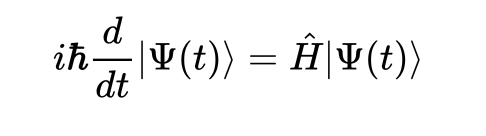 It’s a “mathematical description”. The physical phenomena it describes is how a quantum system (e.g., a helium atom) changes over time (e.g., how the position of electrons within it change). It’s “mathematical” because the statement (the picture above) of the description contains various mathematical “concepts” like an equation, imaginary numbers, etc. Now, if equations are “concepts” why am i calling schrodinger’s equation a “mathematical description” and not a “concept”? Because, remember, a mathematical “description”, as i’m using it, is specific to describing some concrete, physical phenomena whereas a mathematical concept is general and uncoupled to any specific phenomena. An equation is a mathematical concept. A specific equation describing a physical phenomenon, like Schrodinger’s equation, is a mathematical description. As an another example, consider complex numbers, which are a “mathematical concept”. They’re used in many different and unique mathematical descriptions of various different physical phenomena and even in purely mathematical contexts (i.e., with no relation physical reality at all), whereas schrodinger’s equation is coupled with specific physical phenomena and only makes sense in relation to them. This distinction between “mathematical descriptions” and “mathematical concepts” is important because the strangeness of the aforementioned effectiveness of math is going to surface from discussing the various the developmental methodology of mathematical concepts, not mathematical descriptions. In this sense, the mathematical descriptions (the laws of physics) are just being discussed because they are a vehicle for mathematical concepts to be deployed in our understanding of the physical world.
Now, you might annoyingly, but reasonably, point out that i’ve been defining things like “mathematical description” and “mathematical concept” but i’ve not even touched upon what “math” is. Well, I take it to be whatever mathematicians are doing. More seriously, defining math, and other such things, robustly, is difficult. Much ink has been split pontificating over it and i would like to contribute no more. Moreover, i don’t think it actually matters. Your pre-theoretic notion of “math”, that is, before i vomit out some “robust” account of what math is that i’ve parroted from some philosopher, is likely the same as mine.
Appendix D: Is Math Actually Effective In Helping Us Understand the World?
Wigner provides a short treatment of this matter, providing an example of how mathematical concepts play a crucial role in enabling the mathematical descriptions of Quantum Mechanics: “There are two basic concepts in quantum mechanics: states and observables. The states are vectors in Hilbert space, the observables self-adjoint operators on these vectors. The possible values of the observations are the characteristic values of the operators - but we had better stop here lest we engage in a listing of the mathematical concepts developed in the theory of linear operators.” “Ah yes Wigner, that makes complete sense!”, I enthusiastically exclaim, nodding along vigorously, while not knowing what the hell a Hilbert space is. Though this is a good example of the indispensability of mathematical concepts in physical laws (i’ve now looked up what a Hilbert space is), I want to go further in reinforcing the effectiveness of math with some of the considerations that made me more clearly see it.
Consider, first, the ubiquity and breadth of mathematical descriptions. My prior understanding was that math was a nice tool used occasionally to model things in physics, in this or that sub-field and under amenable conditions. That is, i thought a select few things were accurately describable by math. As such, Wigner’s example above didn’t change much for me due to its specificity. Thus, it was important for me to realize that theories across the gamut of physics describe the universe’s regularities mathematically. Consider the following small selection: newton’s law of universal gravitation, Einstein’s field equations in the theory of general relativity, Maxwell’s equations of electromagnetism, and shrodinger’s equation in quantum mechanics. In this sampling, of which many, many more can be given, mathematical descriptions (i.e., the equations) are used to describe diverse phenomena (gravity, electromagnetism, quantum states) and under varied conditions (supra and sub atomic scales, weak and strong gravitational fields, speeds close and far from the speed of light). That is to say, the efficacy of math is not restricted to a few cherry-picked areas in physics that happen to be amenable to it, while the rest remain untamed by mathematical description.
Moreover, not only are a wide range of phenomena under varied conditions described mathematically, those descriptions are stunningly accurate. Consider, again, Newton’s law of universal gravitation (henceforth, LUG), which is formulated as a simple equation F = G (m1 * m2)/r^2. Predictions of the positions of planets based on it are within a few arcseconds of accuracy over time intervals of years. To put how accurate this is into context, an arc second is 1/3600 of a degree and this discrepancy is cumulative, taking years of planets orbiting to reach even that tiny deviation! Another confirmation of the accuracy of LUG came from the discovery of Neptune, whose existence was inferred based on the observed perturbations of Uranus’s orbit and whose predicted position was only off by one degree from the actual position. Einstein’s theory of general relativity, which conceptualizes and mathematically describes gravity differently, is even more accurate. Whereas predictions for the perihelion (the point where an orbiting object is closest to the Sun) of Mercury based on LUG are off by 43 arc seconds per century (still incredibly small!) compared to observations, predictions based on general relativity are essentially equivalent to the observations, being less than 1 arc second per century different. Though there are many, many more tests of GR showing its stunning accuracy, the prize for the most accurate theory in physics goes to quantum electrodynamics (QED), which mathematically describes how photons and electrically charged particles (like electrons) interact. QED’s predictions agree with experimental results up to 12 decimal places, or, one part in a trillion. As Richard Feynman creatively puts it, this is “the equivalent of measuring the distance from Los Angeles to New York, a distance of over 3,000 miles, to within the width of a human hair.”
Then there’s also the ability of mathematical descriptions to condense many phenomena. Imagine a world where we had mathematical descriptions of diverse phenomena and they were stunningly accurate (i.e., the two aforementioned points), but they were incredibly numerous. For example, pages and pages filled with equations to describe magnetic and electric phenomena. But that’s not what we see. Instead, we see instances of unification of many different phenomena under a few descriptions, such as when James Clerk Maxwell was able to extend classical physics to include all the electric and magnetic phenomena by just four equations. In this sense, mathematical descriptions compress the world tremendously, allowing us to restate a plethora of observations in less units of information.
Consider also the indispensability mathematical concepts have in enabling mathematical descriptions. Take the role of complex numbers in Quantum Mechanics (QM), where many of the equations, such as shrodinger’s equation, are inherently complex-valued. Now, whether QM needs complex numbers or it can be formulated using only real numbers, albeit with more difficulty, is not something i have the requisite math and physics knowledge to discern. Though, Wigner seems to suggest the former: “The use of complex numbers is in this case not a calculational trick of applied mathematics but comes close to being a necessity in the formulation of the laws of quantum mechanics”. In any case, the fact that so many equations in QM are complex-valued and that such formulations have stuck around despite reluctance and attempts to remove them from the beginning, shows that, at the very least, they are manifestly practical over their real alternatives, if not necessary. This is quite remarkable, because here you have an unintuitive mathematical concept without a clear empirical referent, that, if we didn’t conceive of, would result in great difficulty describing certain physical phenomena, if we could at all. Or consider that when Einstein was working on the theory of General Relativity, in which gravity is modeled as curvature in spacetime, he had to turn to concepts like the Riemann curvature tensor developed in theoretical math decades earlier. As Wigner mentions (and he provides different examples like borel sets, linear operators, and so on), such examples “could be continued almost indefinitely”.
So far i’ve been discussing how math is used in the statement of descriptions of physical phenomena, and it’s stunning effectiveness in that role. But there’s another role in which math is effective, which i’ve alluded to: the role of actively discovering said descriptions. In this role, the physicist peculiarly discovers reality through a mathematical investigation and not an empirical one. One classic example is that of Maxwell’s equations, which predicted electromagnetic waves, the existence of which was only later experimentally confirmed by Heinrich Hertz.
4.1: An objection
It might be said that the aforementioned effectiveness of math in the role i’m concerned with is blunted when we take into account that the mathematically formulated physical laws/theories are only approximate. For example, LUG is “wrong” in incredibly strong gravitational fields or when objects are moving near the speed of light. It’s “wrong” in light of a more accurate theory of gravity, namely general relativity. And perhaps there is an even more accurate theory than GR that we could confirm is better if we had more sensitive tests and measurements. As such, perhaps we are and can only grasp at good and better approximations, never to reach the underlying implementation of the fundamental behavior of the world.
While it’s true that such laws are not literal descriptions of reality and are instead approximations, I don’t think it really matters. At the end of the day, they are still immensely useful approximations that are indispensable to our understanding of the physical world, as detailed in the previous section. And that they are so useful, even if approximations, is all that is needed to surface the puzzle of the effectiveness of math. Imagine if there was a monkey that was somehow drawing maps that happened to correspond to actual cities. That would be obviously strange for a multitude of reasons. Now imagine if it got a few street names wrong and someone came along and said “Look! It got a couple of street names wrong. It’s just drawing approximations of the city, there’s nothing strange about this at all!”, completely overlooking the fact that it’s a monkey…that’s drawing maps…that are stunningly accurate…even if not perfect.
Sources
- The Applicability of Mathematics as a Philosophical Problem by Mark Steiner
- https://www.maths.ed.ac.uk/~v1ranick/papers/wigner.pdf
- http://www.haraldwiltsche.com/uploads/5/0/4/6/50464133/problem_penultimate.pdf
- https://static1.squarespace.com/static/59d66bb62278e7f2e9356b11/t/59de9651017db2023d692a3d/1507759703071/Match.pdf
- https://ned.ipac.caltech.edu/level5/March02/Hamming/Hamming.html
- http://www.colyvan.com/papers/miracle.pdf
- https://static1.squarespace.com/static/59d66bb62278e7f2e9356b11/t/63f7a51779e883735f2f2d71/1677174040794/Hammin+Wigner.pdf
- https://iep.utm.edu/math-app/
- Wigner’s Puzzle for Mathematical Naturalism by Sorin Bangu
- https://en.wikipedia.org/wiki/Tests_of_general_relativity
- https://www.macmillanlearning.com/studentresources/college/physics/tiplermodernphysics6e/more_sections/more_chapter_2_1-perihelion_of_mercurys_orbit.pdf
- https://www.cambridge.org/core/books/abs/gravitation-and-spacetime/newtons-gravitational-theory/AE349DAC0A37391A7E22D19EB4BC0237
- https://en.wikipedia.org/wiki/Discovery_of_Neptune
- https://en.wikipedia.org/wiki/Precision_tests_of_QED
- https://www.rep.routledge.com/articles/thematic/realism-in-the-philosophy-of-mathematics/v-1
- Philosophy of Mathematics (Handbook of the Philosophy of Science)
- An Introduction to the Philosophy of Mathematics by Mark Colyvan
- Philosophy of Mathematics by Stewart Shapiro
- https://www.zhangzk.net/docs/quotation/TheMathematician.pdf
other sources 24. https://www.youtube.com/watch?v=re-kuNbHd4A 1. simple breakdown of oppy and craig 25. https://www.youtube.com/watch?v=8WE1y00bwCU 1. craig and oppy debate
-
https://www.youtube.com/watch?v=wL6Vt6S22ws
- theism and the applicability of math, long vid
- has a lot of overlap with source 10 but has more i think
-
https://www.youtube.com/watch?v=HmKzTLjddmQ
- another craig video short, non-animated
- doesn’t mention the apriori stuff. Just mentions that the world is imbued with such a mathematical structure and that’s to be expected on theism
-
https://www.maverick-christian.org/2020/08/mathematical-argument-for-god-debunked.html
- hard drive analogy
-
contemporary arguments in natural theology ch 11
- has a lot of overlap with the long vid
-
https://www.crossway.org/articles/one-argument-for-the-existence-of-god-mathematics/
- calls out the underlying structure of the universe being mathematical and our ability to perceive it. Addresses some critiques like mathematical structure being necessary
- not that useful
-
https://www.biola.edu/blogs/good-book-blog/2015/is-the-applicability-of-mathematics-necessary
- addresses the contention that the mathematical structure is necessary, but doesn’t do it well.
- basically says it seems plausible it could have been another way (i.e., chaotic), or that it could only be describable by simple, elementary concepts like arithmetic. He says then it seems implausible that the complex mathematical structure is by chance, and it seems more plausible that its by design.
-
- isn’t useful, recording just to know that i went over it
-
https://www.reasonablefaith.org/writings/question-answer/god-and-the-applicability-of-mathematics
- isn’t useful, recording just to know that i went over it
- DONE FOR NOW
-
- addressing the brute contingency point
-
https://www.reasonablefaith.org/writings/question-answer/is-the-world-a-brute-contingent
- also addressing the brute contingency point
-
https://www.reasonablefaith.org/writings/question-answer/the-applicability-of-mathematics-once-more
-
https://www.youtube.com/watch?v=QJBOiZXkKu8
- craig animated vid
- don’t really like the formulation of this argument. Needs to do better explaining why God is the best explanation.
Quotes
I find it quite amazing that it is possible to predict what will happen by mathematics, which is simply following rules which really have nothing to do with the original thing.
- feynman
Beauty is the first test: there is no permanent place in the world for ugly mathematics.
It is very strange that mathematicians are led by their sense of mathematical beauty to develop formal struc- tures that physicists only later find useful, even where the mathematician had no such goal in mind. [ … ] Physi- cists generally find the ability of mathematicians to antic- ipate the mathematics needed in the theories of physics quite uncanny. It is as if Neil Armstrong in 1969 when he first set foot on the surface of the moon had found in the lunar dust the footsteps of Jules Verne
- steven weinberg, Weinberg 1993, 125
The mathematician plays a game in which he himself invents the rules while the physicist plays a game in which the rules are provided by Nature, but as time goes on it becomes increasingly evident that the rules which the mathematician finds interesting are the same as those which Nature has chosen. (Dirac 1939, 124)
- from match made on earth paper
We are confronted with the peculiar fact that matter seems to comply entirely to the formalism of mathematics. There arises an unforeseen harmony of being and thinking, which for now we have to accept like a miracle. (Hilbert 1992, 69; our translation)
- from match made on earth paper
“the fact that it is comprehensible is a miracle” - albert einstein
- The eternal mystery of the world is its comprehensibility…The fact that it is comprehensible is a miracle
As einstein put it: “How is it possible that mathematics, a product of human thought that is independent of experience fits so excellently the objects of physical reality”
As wigner put it: “The miracle of the appropriateness of the language of mathematics to the formulation of the laws of physics is a wonderful gift which we neither understand nor deserve”
every one who is seriously engaged in the pursuit of science becomes convinced that the laws of nature manifest the existence of a spirit vastly superior to that of men, and one in the face of which we with our modest powers must feel humble.
- einstein
God used beautiful mathematics in creating the world
- Dirac
A theory with mathematical beauty is more likely to be correct than an ugly one that fits some experimental data
- Dirac A physical law must possess mathematical beauty
- dirac
There is no logical reason why [the method of mathematical reasoning] should be possible at all, but one has found in practice that it does work and meets with considerable success.
- Dirac
The research worker, in his efforts to express the fundamental laws of Nature in mathematical form, should strive mainly for mathematical beauty
- dirac
a sort of faith with us that any equations which describe fundamental laws of nature must have great beauty in them. It was like a religious faith with us - Dirac
The mathematician’s patterns, like the painter’s or the poet’s, must be beautiful; the ideas, like the colours or the words, must fit together in a harmonious way. Beauty is the first test: there is no permanent place in the world for ugly mathematics …It may be very hard to define mathematical beauty, but that is just as true of beauty of any kind-we may not know quite what we mean by a beautiful poem, but that does not prevent us from recognizing one when we read it.
- gh hardy
The mathematician has a wide variety of fields to which he may turn, and he enjoys a very considerable freedom in what he does with them. To come to the decisive point: I think that it is correct to say that his criteria of selection, and also those of success are mainly aesthetical… . One expects a mathematical theory not only to describe and classify in a simple and elegant way numerous and a priori disparate cases. One also expects “elegance” in its “architectural,” structural makeup… . These cri- teria are clearly those of any creative art. (Von Neumann 1956, 2062)
I doubt my sense of beauty is a reliable guide to uncovering fundamental laws of nature, laws that dictate the behavior of entities that I have no direct sensory awareness of, never had, and never will have. For it to be hardwired in my brain, it ought to have been beneficial during natural selection. But what evolutionary advantage has there ever been to understanding quantum gravity
- sabine hossfender 2018
“I remember that, when I learned general relativity in the 1950s, before modern radar and radio astronomy began to give impressive new evidence for the theory, I took it for granted that general relativity was more or less correct. Perhaps all of us were just gullible and lucky, but I do not think that is the real explanation. I believe that the general acceptance of general relativity was due in large part to the attractions of the theory itself—in short, to its beauty”
- Steven weinberg
Perhaps the original sources of mathematics were forced on us, but as in the example I have used we see that in the development of so simple a concept as number we have made choices for the extensions that were only partly controlled by necessity and often, it seems to me, more by aesthetics. We have tried to make mathematics a consistent, beautiful thing, and by so doing we have had an amazing number of successful applications to the real world.
- same hamming paper